Showing posts with label journalism. Show all posts

Monday, 14 January 2013

The Ugly German Returns


The Greeks, unhappy at the austerity regime imposed as part of the ongoing euro crisis, accuse the Germans of being Nazis.  Now the Germans are accusing the Germans of being Nazis!  The Germans here are the editors of Der Spiegel, the country’s leading news magazine.  For them the past is not a foreign country; it’s part of a living present.

Last month they published an article by one Dirk Kurbjuweit, lamenting that the ‘ugly German’ has once again reared his head, the ‘ugly German’ being racist, arrogant and in thrall to the nation’s Nazi past (Why Germany Can’t Shed Its Troubling Past, 10 December). 

It was so different a few years ago.  In 2006, when Germany hosted the soccer World Cup, the country was in a party mood.  It was all wonderfully inclusive; everyone was invited to join – “Sixty years after World War II and the Holocaust, the nation of perpetrators seemed to have come out from under its depression, and the world seemed prepared to take these Germans into its heart.”  Alas, no longer; now darker shadows have been cast along the land, at least according to Herr Kurbjuweit. 

This self-flagellation comes not long after the publication of I Sleep in Hitler’s Room: an American Jew Visits Germany by Tuvia Tenenbom, a theatre director in New York.  Actually the German title, Allein unter Deutschen (Alone among Germans), is a lot less controversial.  I’ve not read this but according to another piece in Der Spiegel it’s a “bold, funny and often outrageously absurd travelogue.”  Bold, certainly, in “outing the Germans as anti-Semites”, though the Germans in question seem to be fairly marginal, the sort of cranks and oddballs one might find in some dingy bar in, say, New York.

This makes no difference to the masochists of Der Spiegel.  Whip! Whip!; how awful we are, the magazine laments.  Germans are the gloomy Germans once again, it says, though what exactly has changed in six years I can’t quite pinpoint.  OK, there is the aforementioned crisis with the benighted European single currency but Germany seems to be riding that very well.  There is no parallel here with the Great Inflation of the early 1920s, which gave the Nazis an early boost, and the Great Depression of the 1930s, which brought Hitler to power. 

The simple fact is that Der Spiegel doth protest too much.  It casts its eye over 2012, uncovering “much that hints at the country’s Nazi past.”  If I tell you that one of the ‘hints’ was a lengthy debate whether a Russian opera singer with a swastika tattoo should be allowed to sing at the Bayreuth Festival, the annual Wagner Party Rally, that might just give a hint over how ‘obsessed’ the Germans actually are. 

The truth is simple enough, though far too simple for the editors of Der Spiegel.  There is indeed a neo-Nazi fringe in Germany but that’s exactly what it is – a fringe.  Contrary to what Kurbjuweit alleges, the Germans are particularly anxious to shed their horrific past, too anxious, it might be said, when it leads, as it has in the past, to a collective amnesia. 

Der Spiegel is certainly right in asserting that the Nazi story will be with Germany for a long time to come, but their story is, quite frankly, a lot of sensationalist rubbish.  The scandal, they say, is that young Germans in the twenty-first century “feel the need to be neo-Nazis”, thereby corralling all young Germany in a loutish, skin-head dead end. 

The one thing Der Spiegel has not rid itself of is a tendency to reach for tired old stereotypes, the same tendency clearly being demonstrated by Tuvia Tenenbom, a tendency, one might even say, to demonise people, which was indeed a tragic part of the German past.  It’s clearly been revived as part of a cynical attempt to increase this tiresome magazine’s circulation.  This is not serious journalism.  There may very well be more Nazis in New York than the whole of Germany, something Der Spiegel and Mister Tenenbom might do well to consider.  

Sunday, 2 December 2012

Publish and be Damned


The law is an ass, an idiot, so said Charles Dickens’ Mister Bumble the Beadle in Oliver Twist.  I think we can maybe refine that just a little: it’s not the law that is an ass and an idiot but Lord Justice Leveson, who last week produced his report recommending, as anticipated, statutory regulation of the press. 

His conclusion has been welcomed by other asses, not least of whom is Nick Clegg, the Limp Dumb Deputy Prime Minister, a man who could play Bottom the Weaver in A Midsummer Night’s Dream with no need for the ears. 

David Cameron, now twisting on the horns of yet another dilemma, only has himself to blame for his discomfort.  There was no need, as I have said, for this expensive farce in the first place. Breaches of the law by journalists in News International should have been dealt with as breaches of the law, nothing more.  Instead we have this stupid lawyer and his equally stupid acolytes mounting a challenge to press freedom, a freedom upon which all others might be said to hang. 

What irony there is here.  Our democracy is dying anyway, hurried along to extinction by the European politburo in Brussels.  Now if Leveson has his way we can forget about Milton and Wilkes and Orwell; we can forget about all those who defended a free press as an essential adjutant to free speech.  State regulation is the beginning of the end. 

It’s gratifying to see that not all in the present government are as terminally stupid as the insufferable Corporal Clegg.  William Hague, the Foreign Secretary, warned Cameron that statutory press regulation would be warmly welcomed by Vladimir Putin and other petty tyrants around the globe.  According to one insider, Hague said that “…Britain demonstrating that we have a free press is part of our ability to say that we believe in democracy…if we announced statutory regulation this would be used by the Russians to justify all sorts of behaviour.  It is a fundamental part of British foreign policy to have a free press.”

It’s a point of view echoed by Jethro Goko of the Daily News, Zimbabwe’s biggest independent newspaper.  He said that the rest of the world looked to Britain as a model of press freedom and that the phone hacking scandal should not be used as an excuse for government interference.  If Leveson has his way it will be “manna from heaven” for the likes of Robert Mugabe and his kind.  Goko should know.  His own paper was shut down for seven years and only publishes now under state licence.

Here the Spectator, my favourite political weekly, has openly announced in the latest issue that it will not cooperate with any regulatory structure mandated by the state.  Fraser Nelson, the editor, writes that the publication will not attend meetings, pay fines or heed menaces. 

“To do so would be to betray everything The Spectator has stood for since 1828.”  So far as he is concerned Leveson is a no-brainer.  “…our archives [show] how we have been implacably opposed to the principle of state regulation of the press – not because it protects the press, but because it protects the public.” He added that the magazine has a long history of standing up to politicians who want to restrict freedom of speech.

When I think of Leveson I think of one of those antediluvian fossils, the old judges who sit on the bench regularly having to seek enlightenment as lawyers present their cases because there is some aspect of modern life that they do not understand, from Wi-Fi to iPhones.  Leveson does not understand the internet.  A mere twelve of his almost two thousand page tome is devoted to its place in modern life. 

His is a scheme that is effectively twenty years or so out of date, completely ignoring the fact that more and more people get their news from the net, not from newspapers.  The Sun pointed out the absurdity here, saying that it and other papers could be stopped from publishing stories and pictures already seen by millions online. 

A gagged press is a dead press.  With circulation already in sharp decline I’m guessing that in twenty years or so we will no longer have published newspapers, the so-called ‘qualities’ like the Guardian being the first dinosaurs into Jurassic extinction.  Let its ridiculous editor reflect on that as defends Leveson’s attempt to “ensure decent standards.” 

Publish and be damned.  Be damned to state control of the press; be damned to Lord Leveson

Wednesday, 11 July 2012

Through a Glass Lightly


For Tony and Angie and everyone else on the Broo editorial team.

I enjoy writing for BrooWaha.  The Wikipedia article describes it as an “online citizen’s newspaper with a focus on local news.”  That seems rather odd to me.  After all, what is ‘local news’ in the age of the internet?  The briefest of glances will show you that the ‘news’ it reports (actually most of the articles are not news at all) is from here, there and everywhere. Perhaps the world itself is now local.  Our neighbours are all on the moon!   

My own articles cover just about anything that engages my interest.  I’ve been contributing for over a year now, usually three times a week, and in that period I’ve had over a hundred and fifty articles published, the latest another bash at scientology in my regular Tuesday Letters from Ana column (Scientology Child, 10 July).  There is some overlap with Ana the Imp, when I feel it is appropriate, but a goodly number have not been published here or anywhere else.

It’s been an interesting experience for me, an amateur virtual journalist.  Actually my contributions are less journalism, in the sense of hot reports, and more opinion pieces, features and reflections, the kind of thing I specialise in, often with an acidy angle.  Hey, it’s my speciality, a piquant prose sauce! 

I do try to pick up fresh news items, the sort of thing that the BrooWaha audience might not have come across elsewhere in the mainstream media.    A recent report of mine on a live worm being removed from the eye of an Indian pensioner has proved particularly popular, popular enough to have reached the number one spot in the Most Read Articles.  (Worm Found Live in an Eye, 1 July) 

I think I have a feel now for the audience and the sort of thing that is likely to appeal.  Most readers and contributors, though not all, are from the Anglo-Saxon sphere, and of that sphere my assumption is that most are North Americans.  Any decent writer has to reach out their audience, to understand what is likely to swim and what is just as likely to sink. 

I now know that I cannot make my pieces too local or too weighty.  Still, the audience can be unpredictable.  Articles that I thought might only carry a minority interest have climbed high in the readership stakes.  The thing is never to talk down or condescend to people.  I always treat my readers with the same respect, my style not varying at all from the light-hearted to the serious.  I believe I could write with equal ease for the Sun or the Telegraph.  I make no assumption and do I take things for granted; explanation is offered where explanation is needed.  All that matters is clarity.  Good prose is like a window pane, George Orwell wrote, something that I always have in mind.  

Tuesday, 6 December 2011

Brouhaha at BrooWaha


I’ve been writing for BrooWaha, the American-based online citizens’ newspaper, since the end of May, so far contributing over seventy articles on a wide range of subjects, all of the things that reflect my varied interests, from politics to popular culture.

It’s a fine endeavour, an excellent platform for writers of all sorts, superbly run and managed by Tony Berkman and Angie Alainz, one I’m absolutely thrilled to be associated with. Besides writing for the general pool I also contribute a regular Tuesday column, Letters from Ana, chiefly touching on aspects of life in England, though occasionally ranging more widely.

Yes, as I say, I’m delighted to be associated with Broo, invited to participate by Cher Duncombe, the former editor, who was particularly helpful and encouraging. But, alas, there has been a little blood on the carpet of late, after a silly and self-regarding clique decided that they did not like the general direction the paper was taking. They left, now declaring their splendid isolation in a risible and pompous mood, full of inflated self-importance. Personally I feel that Broo is all the better for this cleansing of the Augean Stables.

I honestly could not care less about this childish gang, but what I do care about is the truth. I care when comments are made about me, inaccurate and lying comments by a – Scotch – bear of very little brain and even less understanding, a sort of pathetic journalist manqué. Oh would that my enemy wrote a blog! No mention is made of me by name, of course, (it’s all oblique references to a ‘right-wing writer’) and I’m not going to bother adding a link. I simply intend to return the compliment in a cryptic and crystal mood, just a way of shattering an ego made of glass!

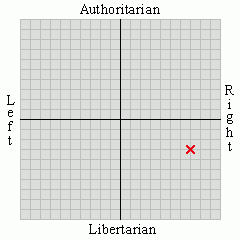
I write in direct and uncompromising style; I write as honestly as I can, with as much integrity as I can, not seeking favour, not attempting to mollify in any fashion. If you can’t stand the heat get out of my kitchen. My articles are almost always opinion pieces based on a substratum of fact, pieces in which I advance my own political perspective, firmly set to the libertarian right.

Inevitably I attract enemies, the small-minded and the intolerant, people who cannot bear to see an alterative view, people who come at me like a blunt-witted hurricane (hurricane, yes, that’s the word!), stalkers of all sorts. It’s always the same wherever I go, wherever my footsteps take me, from My Telegraph to BrooWaha.

People are at liberty to challenge my opinions, something I welcome. What I can’t tolerate is gratuitous and distasteful abuse. If it comes in comments attached to my public articles, so be it; I have a personal policy of ignoring trolls and leave it to the site editors to determine if particular remarks should remain or not.

It’s quite a different matter when it comes to unsolicited personal messages, containing implied threats of all sorts. It happened on BrooWaha. The individual in question, also to remain nameless, was advised to back off, initially, as I understand it, by Ms Duncombe, the former editor, who asked me to let her know if there was any repetition of the problem. Some time after this he complained that he was not allowed to comment on my articles. He was then told by Tony Berkman that it was a matter of indifference to me whether he commented or not, as I would continue to ignore him.

That, as they say, is that. Actually, it wasn't; for further unsolicited messages were sent not long before I left for Egypt, with content that suggested unsettling forms of obsession, content that suggested, at least to me, that this person had serious mental health problems. Supposedly of the political left, he shows unbelievable levels of intolerance bordering on carpet-chewing hysteria. No surprise there, I suppose.

Duncombe having since departed, I reported the matter to Berkman in his capacity as editor-in-chief, for the first time ever revealing the full contents of a private message, partially because the abuse was directed at him as well as me, gibbering, incoherent stuff. The said person was immediately banned, a pity in a way, a pity when any community is diminished, though quite understandable in the light of his bizarre behaviour.

My attention was drawn to the blog I alluded to above, a sort of rambling hate piece, directed chiefly against Berkman. The Scotchman in question, another intolerant lefty (left-wing and tolerance are obvious contradictions), prides himself on ‘facts’, though his own ‘facts’ come in a highly selective form.

First, I was not brought to BrooWaha by Berkman but by Duncombe, following a published interview with me by the former on Blog Catalogue. Second, and more important, the alleged favouritism shown towards me by Berkman is a complete fiction. I have a good working relationship with him but he has never demonstrated any open bias beyond expressing a general agreement with some of the things I’ve written about. The protection he offers to me is such that is offered to all without favour.

The other thing I’m accused of is making derogatory comments about the banned contributor, including supposed suggestions that he was an anti-Semite. Rather odd, considering that I gave up reading his tiresome articles at an early stage and stopped addressing him directly on any subject. He was banned not for “exercising his right to free speech”, something I personally hold sacred, no matter how much I despise particular views, but because of the aforementioned personal abuse.

Maybe the sycophants who congratulated the Scotchman on his plodding skills will read this too, just for the sake of a spot of balance. It’s rather a pity that I no longer have the private messages in question because they reveal so much, meat for all sorts profiling insights. Still, good manners and a hatred of vulgarity in any form would doubtless have prevented me from publishing.

Oh what fun this is, what fools these mortals be!

Thursday, 21 July 2011

Sympathy for the Devil


Earlier this month I wrote about the crisis besetting News International which led to the closure of the News of the World, clearly a cynical exercise in damage limitation which has not limited the damage (The Decline and Fall of the News of the Screws). I think people, particularly British people, are probably sick of this story by now, which looks like running, and running interminably.

The sudden death of Sean Hoare, the journalist who first revealed details of the phone hacking culture on the News of the World, has added to the fevered speculation; oh, sorry, not so much fevered as stupid, the usual evidence-free conspiracy theory that the imaginative love. I met murder on the way – he had a mask like, well, anybody you like really - the Devil, Miss Jones…or Rupert Murdoch.

Things have gone far too far, so much so that I now have to express some sympathy for the Devil, to praise Caesar, not to bury him. I won’t be the first. William Shawcross recently said a word or two in his defence in the Spectator, as did Roger Cohen in the latest issue of Prospect. With the wretched Ed Miliband, the leader of the Labour Party, attempting to whip up a lynch mob against Murdoch and all his works, now is the time for all good people to come to the aid of the party, to speak of the positive contribution that the old Devil has made to British journalism and broadcasting in general.

My view here was already beginning to alter, especially in the light of Miliband’s clownish antics. But it was Gordon Brown’s intervention against Murdoch in Parliament, an act of unbelievable hypocrisy, that made the alteration all the faster.

Then there is the BBC, which has behaved with a nauseating lack of partiality in reporting this story. Its monopoly was threatened by Murdoch’s bid for a controlling share in British Sky Broadcasting, so all the poisons that lurked in the mud hatched out, one presenter on the Today programme going so far as to describe Murdoch as the “most evil man in the world.”

Let’s have a closer look at the Devil, ‘the most evil man in the world.’ Writing before the current crisis, Simon Jenkins, now a columnist in the ultra-Liberal Guardian, said that Murdoch was the “best thing that ever happened to the British media and they hate him for it.”

Yes, the best think that ever happened, and yes, they really do hate him for it; the socialists, the liberals, the pseudo-journalists, bad writers aplenty. By taking on the antediluvian print unions in the 1980s, wedded to practices that would have been thought too restrictive even by medieval guilds, he breathed fresh life into a medium that was effectively dying. He stood by the Times at the most difficult point in that paper’s history, for which alone he deserves praise, not calumny.

He continues to subsidise this journalistic flagship, subsidising the losses it makes from the profits of the Sun, rather an irony considering the differences between the two publications. Our newspaper industry is better and more diverse because Murdoch was prepared to make the bold moves, the moves Anthony Hopkins said in the movie Nixon that make history. As Shawcross says, if Murdoch’s business is destroyed the diversity of the British media will suffer seriously. We will all be the poorer for that.

The thing I can admire most about Murdoch is that he is a great risk-taker, that he plays the long shots with an almost intuitive understanding of what will work and what will not. So far as this country is concerned he is an outsider, a ‘colonial’, but he represents a buccaneering spirit that took Britain so far in the nineteenth century. He stands, in other words, in the tradition of the great innovators and entrepreneurs, a spirit that has just about been bled out of this land.

So much of the comment being made at present is based on petty-spite and envy, when it is not simply motivated by baser political considerations. Murdoch is a modern Citizen Kane, Cohen says, and resentment follows people like him as closely as success. It will take a lot for News International to withstand the pressures that it is presently under. I sincerely hope it does.

However, in the end, Murdoch may quit this country, now little more than an outpost of his international media empire, may quit the various media and broadcasting interests he now holds. In the end excellent papers like the Times, by far the best for foreign coverage, and the Sunday Times may disappear altogether, either that or they will fall into the hands of some Russian gas giant or other rather like a football club, a prospect I personally do not welcome. If I have to have a Devil I would rather have the Devil I know.

Tuesday, 21 September 2010

Worlds to conquer


I hope to have a life as full as that of Virginia Cowles, though, like Alexander, I rather suspect that there are no more worlds to conquer, at least not the kind of worlds that she conquered. You’ve never heard of her, perhaps; well, until recently neither had I, not until I came across a review of Looking for Trouble, her memoir now republished by Faber and Faber, marking the hundredth anniversary of her birth. Here, behold the woman; this is the blurb from the original 1941 edition;

Miss Virginia Cowles has modestly entitled this account of four years as a roving journalist ''Looking for Trouble''. Never was a search more amply rewarded. She has found trouble in Spain – behind the barricades in Madrid, and among the polyglot armies of General Franco. She has found it in Russia, in Germany, in Czecho-Slovakia at the time of Munich, in Roumania during the Polish war, in Finland throughout the Finnish war, In Italy during the ''lull'', in Paris a few hours before the Germans moved in, in London during the ''blitz''.

Yes, she was a war correspondent, or, rather, she became a war correspondent after Hearst newspapers sent her to Spain in March, 1937. She was then twenty-seven years old. Bliss was it in that dawn to be alive, but to be young was very heaven! Cowles arrived in Madrid just after the Battle of Guadalajara, staying in the Hotel Florida, there with the likes of Ernest Hemingway and Martha Gellhorn, his then wife.

Yes, I know, it’s in the middle of a war in a city under siege but the whole thing just seems so impossibly exciting and – I really do have to say this- impossibly romantic! Cowles filed her reports from the Telephone Building in Gran Via, afterwards going off to the fashionable Chicote’s to drink with colleagues and associates.

But she wasn’t like the others, who all too often confused news with propaganda, or like that ghastly communist Claude Cockburn, presented propaganda as news. Though sympathetic to the Republican cause she was aware of the atrocities committed in the name of ‘anti-fascism’. And unlike Martha Gellhorn, dismissive of “all that objectivity shit”, as she put it, Cowles set off in pursuit of ‘all that objectivity shit’, spending several weeks covering the war from the Nationalist side.

Where the news was she was. From Spain she travelled backwards and forwards across Europe, interviewing all sorts of people, generals, statesmen, politicians and journalists. Sensitive to the general atmosphere, her reports warned time and again that war was coming, this despite an ‘assurance’ from the Hitler-loving Unity Mitford, whom she met at the 1938 Nuremberg Party Rally, that there would be no war because the Fuhrer did not want to see his new buildings bombed!

By the time the war came Cowles was a roving reporter for the Sunday Times, going from capital to capital watching “the lights in the death chamber go out one by one”, as she puts it. She was in Berlin the day German soldiers crossed into Poland, in Helsinki when Russian soldiers crossed into Finland. Later she arrived in Paris at a time when the German advanced guard was only seventeen miles from the city. This was war reporting in the raw, an age now gone, when journalists could come and go as they liked, rather than being shepherded, spoon-fed and corralled. From the Ritz in Paris to the Adlon in Berlin, Cowles was there.

It’s quite astonishing the number of people she met, interviewed and socialised with on a face-to face basis. When she was in London she went to see Churchill at Chartwell. In Nuremberg she was part of a select group that had tea with Hitler, Himmler, Goring Goebbels and Heydrich. She was taken flying in a two-seater plane over Tripoli by Air Marshal Italo Balbo in person. In Rome she was given an interview with Mussolini.

In England she dined with Duff Cooper after he had resigned from the cabinet following the Munich Agreement. He told her in beautifully frank terms that he might not have resigned if Chamberlain had been more honest, if he had returned from Munich proclaiming not peace with honour but “peace with terrible, unmitigated, unparalleled dishonour.”

Cowles was particularly fond of England, a calm oasis to which she returned time and again from Continental hotspots. In Looking for Trouble, published in June 1941, long before Pearl Harbor, she celebrates the British wartime spirit, finishing with a call to America to “…fight side by side with Great Britain until we reach a victory so complete that freedom will ring through the ages to come with a strength no man dare challenge.”

After the war she married Aidan Crawley, a fellow journalist who became a Member of Parliament. She went on to write biographies of people as varied as Winston Churchill, Edward VII and Kaiser Wilhelm II, as well as books on the Romanovs and the Rothschilds. Sadly Virginia Cowles was killed in September 1983 in a road accident in Biarritz. Sad, yes, but no life could have been any fuller, any more exciting.