Showing posts with label political theory. Show all posts

Thursday, 18 March 2010

Totalitarianism


Hannah Arendt could certainly draw on some strong authorities for her model of totalitarianism; for none other than Leon Trotsky had said that there was little to separate Stalin and Hitler one from the other, judging by the political techniques that they favoured. And he should know, should he not?

There were similarities, of course there were similarities: both presided over one-party states; both favoured terror and both made fulsome use of propaganda and forms of mass mobilisation. But the analysis of Arendt-and of Trotsky-only serves to confuse more than it enlightens. In terms of both theory and of practice there were real and abiding differences between Hitlerism and Stalinism; between, what might be described as irrational and rational forms of dictatorship.

So, how is this essential difference to be defined? I can put it no better than this: when Martin Bormann's son asked what National Socialism was, he was told quite simply that it was "The will of the Führer." In other words, National Socialism, as a form of political practice, and as a style of government, is inconceivable without Hitler. The system of administration Hitler favoured was devoid of all structure and method; of all lines of bureaucratic authority. At root, it was little better than a form of Social Darwinism, without any discernable rational order. At one point, for example, no less than three separate agencies had an input into foreign policy, all with contradictory aims, and all with equal access to the Führer. As Ian Kershaw has expressed it, "Hitler's leadership was utterly incompatible with a rational decision-making process, or with a coherent, unified administration and the attainment of limited goals...its self-destructive capacity unmistakeable, its eventual demise certain."

If Hitler was Nazism, Stalin was most definitely not Communism. In other words, he did not create the system, nor did he shape it to match the ends of his own ambition. He worked within the existing structures of Soviet power, its ideology and its administrative procedures. This defined both the nature, and, let me stress this, the limitations of his power. There were some things, in other words, that even the great Stalin could not do: he always had to operate within, and pay homage to, a system established by Lenin, a system that went well beyond his authority and presence.

Stalin did not destroy or pervert Leninism: he was its most perfect expression, the superlative bureaucrat, and the greatest of political managers. He worked, above all, to a rational and to a given set of ends, because that was what was expected. There was a degree of stability and predictability to the Soviet dictatorship which simply did not exist in Nazi Germany. It was the nature, the transcendent nature, if you like, of the Communist ideal that enabled Stalin's successor to condemn his 'mismanagement'. No Nazi version of Khrushchev would ever come to accuse Hitler in such terms. The very idea of such a thing is inconceivable.

Wednesday, 17 March 2010

Young, Right and Proud


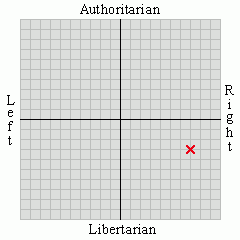
Politically I’m right-wing, not hard right-wing, not soft right-wing; just right-wing. I’m proud to be right-wing, proud to make this declaration, though I’m sure it’s no secret to those who have read my posts here. However, I think there is still a lot of confusion over exactly what it means to be on the political right.

For me the answer is simple. I follow in the footsteps of Edmund Burke; I think the French Revolution and all that followed was a catastrophe, a disastrous mess that introduced dictatorship, terror and collectivist abstractions into the modern political lexicon. I follow in the footsteps of Friedrich von Hayek, believing that The Road to Serfdom is one of the most important books ever written, a kind of Anti-Collectivist Manifesto, a book that exposed the intellectual fictions of the left, seeing that both the Communist and Nazi states had exactly the same roots.

I am right-wing in the way that Ayn Rand was right wing, believing in laissez-faire capitalism, limited government, low taxation and minimal welfare. I believe in libertarianism and what Rand called ethical egoism. I believe the individual should take pre-eminence and I wholly agree with the sentiments behind Margaret Thatcher’s declaration that there is no such thing as society, another misunderstood statement.

I believe welfarism, almost any form of state intervention, to be corrosive of self-respect and individual liberty, to be corrosive of individual identity itself. There was an anxious piece in the hyper-liberal Guardian newspaper recently about the growing influence among Conservatives of the Young Britons Foundation, whose chairman Donal Blaney has had the temerity to call for a scrapping of the National Health Service. My goodness, what a suggestion; what kind of right-wing devil could conceive of such a thing? Well, I could, for the simple reason that the ‘beloved’ NHS is a bloated, inefficient and wasteful monster, a view that I have made clear before. I hate the bogus consensus over this issue, the fear induced in the minds of ordinary people by the political left, a fear that prevents the long-overdue issue of reform even being discussed.

I am right-wing because I believe not just in personal responsibility but liberty, liberty as the guiding principle of my life, liberty within the reasonable limits of law, liberty guaranteed by a night watchman state. Looking over the past I think we, as a nation, took the wrong path in 1945, buying decorations and furniture for a house that was in effectively in ruins. We introduced a welfare culture that did much to destroy personal initiative; a Dracula that only existed by sucking the life out of the economy. A serious attempt was made to change direction after 1979 but not nearly enough, not enough to prevent us settling back into the bad old ways, ways that produced cities like Liverpool and Glasgow, those reservations of deprivation and dependence.

Right is right and left is wrong and never the twain should meet. :-)