Showing posts with label ideology. Show all posts
Monday, 1 August 2011
Breivik and the Left
It’s just over a week now since that dreadful outrage in Norway, that massacre of the innocents in a nation of innocents. The sensible thing to do was to watch and wait before passing comment, but sense is no impediment to opinion, the more ridiculous, the more opportunistic and, yes, I have to say this, the more obscene the better, raking over tragedy to score political points.
Breivik is a cold blooded and calculating sociopath by any reasonable measure. But one could almost feel the sigh of relief that went up on the liberal left. Thank goodness he was not a Muslim; thank goodness that he is an Aryan. Now we really have a target; now we don’t have to make excuses. Attack; he is of the right, all of the right is tainted, all of the right is made up either of sociopaths or those who give intellectual succour to sociopaths.
There are two excellent articles in the latest issue of the Spectator reflecting on this issue, Breivik and the right by Douglas Murray and If you think the left is twisting Norway’s tragedy check out the neo-Nazis by Rod Liddle.
The essential point, as Murray says, is that there is a tendency – particularly strong on the left – to use any horrific act as a megaphone for existing prejudices. Even Tom Harris, a Labour Member of Parliament, remarked on something that was immediately obvious to me – “…a palpable relief…swept through the left when the identity of the terrorist was known…Here, thank God, was a terrorist we can all hate without equivocation: white, Christian and far right-wing. Phew.”
Within days of the attack the New York Times, the American version of the hyper-liberal Guardian, was insisting in a slightly sinister fashion that a “new attention” would have to be focused on “the subculture of anti-Muslim bloggers and right-wing activists.” Murray notes there was no qualification here, no reference to ‘far-right’ or psychopathic extremists, just right-wing activists, a category, incidentally, that includes me, a libertarian blogger, a conservative and a Conservative. Let the witch-hunt commence, the McCarthyism of the left
Beyond readers of the New York Times, people may not be fully aware just how hysterical comment became in Europe. There were those prepared to draw a line directly from the recent denunciations of multi-culturalism by President Sarkozy of France, Chancellor Merkel of Germany and Prime Minister Cameron of Britain to the Norwegian massacre. The Independent, possibly the dullest newspaper on the face of the planet, excepting only Granma in Cuba, turned its fire on Geert Wilders, the Dutch politician who has warned of the dangers of mass immigration.
There is no subtlety at all in this. It’s an attempt to silence debate over an important issue, damning an argument by perverse association. We saw this in England, where for so many years concerns over immigration were denounced as ‘racist’, ironically giving succour to parties and people who were racist. Now the issue is openly acknowledged right across the political spectrum.
Perhaps the most absurd comment of all on the Norwegian massacre came from a certain Lee Jasper, an aid to Ken Livingstone, the former mayor of London. I should say, by way of information, that Livingstone, when he was in office, played abject and fawning host to a certain Yusaf al-Qaradawi, a Muslim cleric who just happens to praise the virtues of suicide bombing, the beating of women and the execution of homosexuals.
None of this matters to Mister Lee, who immediately concentrated fire on Boris Johnson, the present mayor of London, unwise enough to defeat Livingstone in election. What was his offence? Is he an anti-Muslim blogger, is he a Knight Templar, did he encourage Breivik in his lunacy? No, none of this. Apart from the fact that he is a leading member of the Conservative Party his hair is the same colour as Breivik’s, justification enough, surely? Come to think of it, so is mine. I think I detect a pattern.
I would be surprised if many of the people who may read this have ever heard of Stormfront, although the name itself may give sufficient clue over the kind of territory I’m about to enter. It’s a website for a certain kind of political activist, not people one would expect to have anything in common with the New York Times.
But the Hitler-loving Stormfront – yes, if you have not taken the point, this is a site for genuine ‘right wing’ extremists – came out with its own knee-jerk explanation and call for a witch-hunt. One might expect these people to wave flags for Breivik. But, no; he was no more than a tool, you see. Need I tell you for whom? Well, for those who have not guessed, the Norwegian crackpot is an instrument of Mossad and the demonic Jews.
Now I’m going to let Douglas Murray speak for himself, an impressive passage in a particularly impressive piece of journalism;
Some comparisons between Islamist extremists and Breivik are useful. They are certainly similar types of sicko (a fact I hope he comes to realise one day). But there are also salient differences. At least one must be that, in the wake of Breivik’s atrocity, not a single Christian leader, right-wing journalist or right-wing politician (including those cited by him) expressed anything other than condemnation and revulsion for his actions. No ‘ifs’ or ‘buts’. No ‘important to understand the wider context’ or ‘driven to despair’ nonsense. Just horror. Unlike the suicide bombers who gets shrines and public squares named after them, Breivik (like the Brick Lane/Soho bomber) will only be memorialised among a sick and covert coterie of extremist loners who, though undoubtedly dangerous, speak for no one.
Indeed, they speak for nobody; Breivik is nobody. It’s wretchedly sad that there are people so blinded by political and ideological prejudice that they are quite unable to appreciate this simple fact.
Wednesday, 9 February 2011
I Give you the Man

The following was stimulated by an exchange I have just had on one of my social networks. Enjoy. :-)
There are many thinkers and writers that I admire, people who in same fashion or other have made some worthwhile contribution to our common culture, to the culture of humanity. There are also many that I detest, and I make no apologies for using so strong a word, those whose thought and words have had what I consider to be a baleful influence on history.
My attitudes can be quite complex. I can admire the sheer intellectual industry of someone like Karl Marx, while rejecting the political philosophy that arises, dangerously comprehensive, dangerously Victorian in its all-consuming arrogance. But the one figure that I despise more than any other, who, so far as I am concerned, has no redeeming features as a writer or as a man, is Jean-Jacques Rousseau.
First, ecce homo: consider the man, consider the hypocrite. In the mid-1740s he began a relationship in Paris with one Thérèse Levasseur, the details of which ore outlined in Confessions, his autobiography. By this woman he was to have a son and as many as four other children whose names and sexes are not even recorded. One by one Thérèse was persuaded to give these children away to foundling hospitals, places where the mortality rate was even higher than the average for the day.
There is no certain evidence but on the balance of probability all of Rousseau’s children died in these places. He later made one attempt to discover the whereabouts of his son, some ten years after his birth, but no record of his existence could even be found. Edmund Burke was later to write of his conduct:
…his heart was incapable of harbouring one spark of common parental affection. Benevolence to the whole species, and want of feeling for every individual with whom the professors come in contact, form the character of the new philosophy. Setting up for an unsocial independence, this their hero of vanity refuses the just price of common labour, as well as the tribute which opulence owes to genius, and which, when paid, honours the giver and the receiver; and then he pleads his beggary as an excuse for his crimes. He melts with tenderness for those only who touch him by the remotest relation, and then, without one natural pang, casts away, as a sort of offal and excrement, the spawn of his disgustful amours, and sends his children to the hospital of foundlings. The bear loves, licks, and forms her young; but bears are not philosophers. Vanity, however, finds its account in reversing the train of our natural feelings. Thousands admire the sentimental writer; the affectionate father is hardly known in his parish.
Yes, this is the key not just to the man-who was later to lecture women on the best means of child rearing-but the forms of thought he produced, the substitution of arid formulas for genuine feeling and real life. Denis Diderot, another apostle of the Enlightenment, was later to describe Rousseau as “…false, vain as Satan, ungrateful, cruel, hypocritical and wicked.”
Oh, but how he loved in the abstract, how he eulogised the species in his Discourse on Equality and The Social Contract. In these we have people, men, to use his own expression, more as antique Romans than modern Europeans; men who are offered as expressions of ‘virtue’, as gestures of virtue, if you prefer, who may very well have escaped from the paintings of Jacques-Louis David.
What is to be done?, Rousseau asks at the conclusion of The Social Contract. Cultivate virtue, the answer comes, a new contract where the individual will find freedom in submitting to the ‘general will.’ Yes, here is the shadow of Robespierre; here is the manifesto of the cold-blooded fanatic, here is the Republic of Virtue; here is the guillotine and the Terror, here is the abstraction coming like a vampire to suck life dry.
Edmund Burke was brilliant in his prescience. As early as 1790, when his Reflections on the Revolution in France was published, he could see the course of events, he could see contemporary moderation turning to destruction and dictatorship. The excesses of the Revolution were no accident. They were built in, rather, from the outset, rooted in Rousseau’s personal vanity, arrogance and general moral failings. They were rooted, I would add, in his failures as a human being coupled with a seductive intellectual power, enough to seduce the likes of Robespierre, Saint-Just, Marat, Desmoulins and all the other ogres of 1789. Rousseau was their spiritual father, just as he stands as the spiritual father to all of the tyrannies that followed. Rather apt for a man who had not the courage to be a real father.
Monday, 12 July 2010
Father of the Age

Late this afternoon I finished reading Molotov’s Magic Lantern, Rachael Plonsky's idiosyncratic and brilliant journey through modern Russian history, taking as her point of departure the books she found in the Moscow apartment of Stalin’s former foreign minister and co-executioner. I intend to write a review over he next few days but I'm adding this, I'm adding what you are about to read, in a kind of intellectual ferment. It's an impression on the same basis as the painting style. Forgive me if it seems a little incoherent. Quite simply, it's raw thought.
Molotov, or Vyacheslav Skryabin, his real name, was a product of an age. Europe has been divided by historians into distinct phases or ages - the Renaissance, the Enlightenment, the Age of Reason, all quite arbitrary when one thinks about it. For me the last century up to the fall of the Soviet Union is best defined as the Age of Ideology, the age when human destiny was guided by one malevolent idea or another.
Yes, malevolent. How does one understand a man like Adolf Hitler? How does one understand a school drop-out, a man who disgraced and betrayed his family, who sank into the most abject sections of Viennese society? But for the First World War this man would have died in complete obscurity in some common lodging house in Vienna or Munich. But his pathology was Germany's pathology. The war, which really did pull out the roots of European civilization, gave him his opportunity; ideology gave him his opportunity.
But that was not enough, Germany’s defeat and sense of grievance was not enough; there had to be something more; there had to be a Moses, one who brought the commandments of the Age of Ideology down from Mount Sinai. The Moses was Vladimir Ilyich Ulyanov, Russian, Kalmyk and Jewish, Lenin, to use his alias, in my estimation the most vile, most malevolent human being who ever lived, and, oddly enough, the apotheosis of mediocrity.
I saw him when I was in Moscow - if it is him and not a wax replica. Inwardly I could feel nothing but contempt. Every evil that you have ever conceived, every evil of the Age of Ideology is his. Hitler is nothing; Hitler was merely an epiphenomena. He, along with Stalin, Trotsky, Mussolini, Mao, Pol Pot and the rest of the monsters are simply inconceivable without Lenin. Some of his children may be bastards but they are still his children.
The remarkable thing is that he was crushingly dull, not at all charismatic. His writing is second-rate, hysterically polemical and almost always off target. His oratory, from what I can gather, was even worse. If he is evil his evil is even more banal than that of that stupid apparatchik Adolf Eichmann. I can't understand, I don't understand, why history threw up this bourgeois mediocrity other than as some massive joke.
I remember reading the comment of a Russian after he'd seen him in Red Square for the first time, after it was safe to express an honest opinion. His hope was that Ulyanov would remain like this forever, not buried with his mother as he had wished, that he should remain as an exhibit for the idle and the curious to gawp at as if visiting an exhibition of stuffed animals prepared by a taxidermist. He should remain like this for the sacred soil of Russia would simply refuse to hold him. Amen
Wednesday, 17 March 2010
Young, Right and Proud

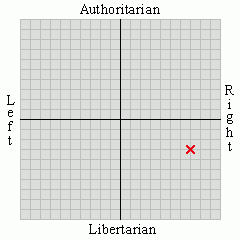
Politically I’m right-wing, not hard right-wing, not soft right-wing; just right-wing. I’m proud to be right-wing, proud to make this declaration, though I’m sure it’s no secret to those who have read my posts here. However, I think there is still a lot of confusion over exactly what it means to be on the political right.
For me the answer is simple. I follow in the footsteps of Edmund Burke; I think the French Revolution and all that followed was a catastrophe, a disastrous mess that introduced dictatorship, terror and collectivist abstractions into the modern political lexicon. I follow in the footsteps of Friedrich von Hayek, believing that The Road to Serfdom is one of the most important books ever written, a kind of Anti-Collectivist Manifesto, a book that exposed the intellectual fictions of the left, seeing that both the Communist and Nazi states had exactly the same roots.
I am right-wing in the way that Ayn Rand was right wing, believing in laissez-faire capitalism, limited government, low taxation and minimal welfare. I believe in libertarianism and what Rand called ethical egoism. I believe the individual should take pre-eminence and I wholly agree with the sentiments behind Margaret Thatcher’s declaration that there is no such thing as society, another misunderstood statement.
I believe welfarism, almost any form of state intervention, to be corrosive of self-respect and individual liberty, to be corrosive of individual identity itself. There was an anxious piece in the hyper-liberal Guardian newspaper recently about the growing influence among Conservatives of the Young Britons Foundation, whose chairman Donal Blaney has had the temerity to call for a scrapping of the National Health Service. My goodness, what a suggestion; what kind of right-wing devil could conceive of such a thing? Well, I could, for the simple reason that the ‘beloved’ NHS is a bloated, inefficient and wasteful monster, a view that I have made clear before. I hate the bogus consensus over this issue, the fear induced in the minds of ordinary people by the political left, a fear that prevents the long-overdue issue of reform even being discussed.
I am right-wing because I believe not just in personal responsibility but liberty, liberty as the guiding principle of my life, liberty within the reasonable limits of law, liberty guaranteed by a night watchman state. Looking over the past I think we, as a nation, took the wrong path in 1945, buying decorations and furniture for a house that was in effectively in ruins. We introduced a welfare culture that did much to destroy personal initiative; a Dracula that only existed by sucking the life out of the economy. A serious attempt was made to change direction after 1979 but not nearly enough, not enough to prevent us settling back into the bad old ways, ways that produced cities like Liverpool and Glasgow, those reservations of deprivation and dependence.
Right is right and left is wrong and never the twain should meet. :-)
Subscribe to:
Posts (Atom)