Wednesday, 4 April 2012

Big Brother might just watch you


To the future or to the past, to a time when thought is free, when men are different from one another and do not live alone — to a time when truth exists and what is done cannot be undone: From the age of uniformity, from the age of solitude, from the age of Big Brother, from the age of doublethink — greetings!

These are the words with which Winston Smith opens his journal in George Orwell’s novel Nineteen Eighty-Four. I begin to worry that at some time in the near future I may have to open my own secret channel of communication, because our benighted government is proposing to monitor the email and phone calls of all private citizens.

It’s a Frankenstein Monster the previous Labour government unsuccessfully tried to electrify into life six years ago. Now it has been brought out of the crypt. David Davis, the soul of the Conservative Party, at least has the wit to see what Prime Minister David Cameron cannot: this is going to cause a huge amount of resentment. The idea of it, the idea that we will be subject to levels of state intrusion more common in places like Iran or China, simply makes my blood boil.

Although the new proposals, to be introduced in the next session of Parliament, do not include a national database, something the Labour government was keen on, internet service providers will be required to record all online activity, to be accessed on demand. It would be a dream for the likes of G Gordon Liddy and all such petty snoopers. Hey, there is no need to burgle Watergate; we have all the information we want at our electronic fingertips!

This comes, I should add, in the face of a previous promise by our benighted Coalition government to end the storage of internet and email records without good reason. So why the reversal, why this descent into super snooping? It’s a way, goes the official line, of combating terrorist and paedophile networks. In other words, it makes potential terrorists and paedophiles of us all.

Shami Chakrabarti, director of Liberty, a civil rights group, reminds us that the Conservatives and Liberal Democrats were active in their opposition to Labour’s 2006 proposals. “There is an element of whoever you vote for the empire strikes back”, she said. “This is more ambitious than anything that’s gone before. It’s a pretty drastic step in a democracy.”

Not only that but it seems to me to be particularly stupid blunt instrument, and I imagine a massively expensive one. Crime and terrorism need to be fought but in a targeted fashion, not by this kind of idiotic mass surveillance. My confidence in this wretched government diminishes by the day, Conservatives who are not conservatives, Liberals who are anything but liberal.

I do not suppose for a moment that Big Brother seriously wants to monitor Ana’s emails or phone calls, but the very idea that he might is deplorable. We will simply never know if we are being watched or not. Our freedom, once again, will be diminished, our ancient liberties further undermined. The terrorists who seek to destroy our civic tradition must be delighted. Their work is being done for them by stupid politicians and power mad bureaucrats.

Here comes a candle to light you to bed,
And here comes a chopper to chop off your head.


Postscript

I wrote this last night in a passion. The latest information I have is that the U has been turned; that the absurd Theresa May, the Home Secretary, has been hoist with her own petard; that Nick Clegg, the deputy prime minister, has said that the legislation will only be published as a ‘draft’, which means it will be ignored as daft. My goodness, how true it is: those whom the gods wish to destroy they first make ridiculous!

Tuesday, 3 April 2012

Athos and the Third Rome


I had never heard of the Theocratic Republic of Athos until recently. If you have never heard of it either it’s to be found on the easternmost prong of the trident-like peninsula that projects from northern Greece into the Aegean Sea.

Oh, I knew that Athos was the host to a community of Orthodox monasteries, Russian, Bulgarian and Serbian as well as Greek. I also knew that is a place closed to women. What I was unaware of was its unique political status as a self-governing though not independent entity. But what makes it of particular and topical interest is that it now stands at the centre of a religious struggle, one that largely seems to have escaped attention in the non-Orthodox World, a struggle that opens the door to the ghosts of vanished empires.

In an article in the April edition of the BBC History Magazine, David Keys says that Athos, the Holy Mountain, as the Greeks refer to it, might be considered as the last surviving remnant of the Roman Empire. It was given its status by the Byzantine emperor Basil I in 885, as a monastic territory within the Empire. This unique identity was preserved through the long centuries of Ottoman occupation.

Although the monks finally accepted the sovereignty of the emerging Greek state, Athos was formally recognised in the national constitution of 1926 as a self-governing theocratic republic, officially known as the Autonomous Monastic State of the Holy Mountain. On spiritual matters the territory comes under the supervision of the Eastern Orthodox Patriarch of Constantinople, long resident in Turkish Istanbul.

If you think that things can’t get any more complicated they do! Just as Greece is struggling for its political soul with Germany, there is a struggle for the Orthodox soul with Russia. Remember Athos is an international community representing the whole of the Orthodox world. There were points during the last century when the majority of monks were Russian, though the Greek government has since restricted a non-Greek presence.

So far so nothing, and Athos might have continued to slumber in spiritual isolation, but for one thing…some of the monks are getting a bit bolshie! Recently two of the peninsula’s twenty monasteries have been in trouble with the police. Why? Because they are refusing to pray for the Patriarch. The implication here is that he has no spiritual authority over them, a violation not only of church hierarchy but also a violation of the 1926 constitution.

Things have been taken to the point where the police have been trying to expel the monks of the tenth century Esphigmenou monastery. In another case Abbot Ephraim of the tenth century Vatopedi monastery has been arrested as part of a corruption scandal. But the dissidents have a champion. Turn now and look to the Third Rome. Abbot Ephraim has become an icon in Moscow!

It was after the fall of Constantinople, the second Rome, to the Turks in 1453 that the title began to settle on Muscovy, with the clear implication that Russia was now the centre of the Orthodox world. “Two Romes have fallen. The third stands. There will be no forth.”

The Third Rome did fall, or rather was eclipsed for decades by the communists. But the demise of the Soviet Union has seen a remarkable revival of the Orthodox Church. In the years since Gorbachev’s Christmas Day farewell 25000 new churches have been built. Today some seventy per cent of the world’s Orthodox community live in Russia and the Ukraine. A new vibrancy has brought with it a new assertiveness, with Moscow seeking primacy over Constantinople.

Ephraim is particularly prized. Last year he allowed a textile belt said to have been worn by the Virgin Mary, one of Athos’ most sacred relics, to leave Greece for the first time ever. It went with him on a tour of Russia, where it was seen by an estimated three million people, some of whom queued for twenty hours. By sheer coincidence (of course it was) Ephraim was arrested soon after his return with the belt, something that could not have happened, as Keys writes, without the tacit neutrality or agreement of the Constantinople Patriarch.

Actually the ramifications here are even wider. The whole question has been caught up in a new cold war between Russia and America. Unbeknown to me, Washington regards support for the Patriarch as an important part of its foreign policy. Over the past few years he has been visited in Istanbul by Vice-President Joe Biden and Secretary of State Hilary Clinton, just to bolster the old chap over his Moscow rival. The Greeks, increasingly worried about their own identity, are no less anxious to secure this ancient link and their pre-eminence in the Orthodox universe.

The trouble is, given his position in a Muslim country, the Constantinople Patriarch, once as powerful as the Pope in Rome, is an isolated figure. Successive patriarchs were really only able to preserve a primacy paradoxically thanks to the persecution the Russian Orthodox suffered at the hands of the communists. Now the Russian Church wants to give proper meaning to the concept of the Third Rome, many seeing Moscow as the rightful successor to the Byzantine patriarchy.

How did the Autonomous Republic get caught up in this, you may wonder? Simply this: it’s a traditionally conservative community and many of the monks, not just in the foundations I’ve mentioned, are openly critical of the Constantinople patriarchate, which they see as too ecumenical and too liberal. Alienation from Constantinople has entailed admiration of Moscow and the renaissance of Russian Orthodoxy.

To complicate things one stage further (yes, I know, I know!) the Republic is also in conflict with the European Parliament, which is calling for the thousand-year-old ban on the entry of women into the celibate community to be ended. Just how much ‘autonomy’ the Autonomous Republic truly has is clearly open to question. Come to that, just how much autonomy any of us have, religious or not, is also open to question. Turkey swallows the Patriarch; Greece swallows Athos; Europe swallows Greece. Perhaps the only independence left is to be found in the Third Rome. What a depressing thought to conclude with.

Monday, 2 April 2012

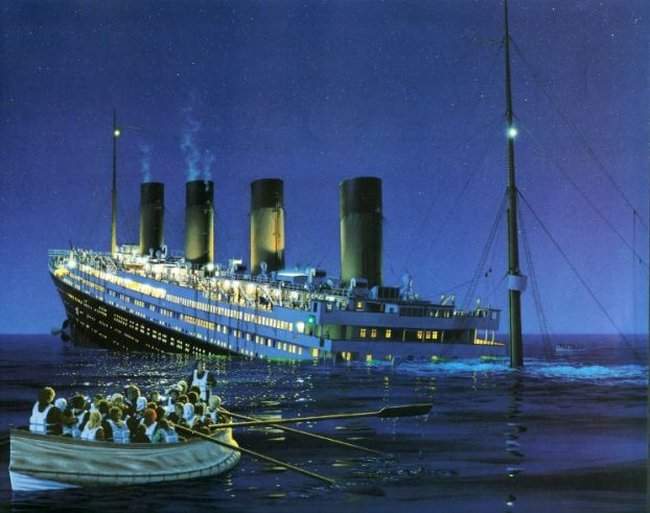
The Unsinkable Titanic


James Cameron’s 1997 epic Titanic is shortly to be released in 3D to coincide with the hundredth anniversary of the sinking of the unsinkable this month. I saw, and loved, the original when I was a child. I’ve seen it several times since and am not likely to go to the cinema simply for a few wow-me visual afterthoughts.

I dare say a lot of people will go, a new generation who will be coming to it for the first time; coming to the story of Rose and Jack, star and class crossed lovers, playing out their time in the shadow of a greater drama.

The story of the Titanic itself has moved beyond history into mythology. Like all great myths it really stands as a metaphor for the human condition, capable of multiple interpretations, meanings shifting from one generation to the next. In one preview I read of the reissue of the Cameron film the writer said that it was a metaphor for a troubled global economy. Yes, I can just see how the ostentatious luxury of the first class passengers, oblivious to the icy crash to come, would feed happily into the preconceptions of the Occupy shower in London and New York!

The anniversary of the disaster has also occasioned a BBC mini-series scripted by Julian Fellowes, the creator of Downton Abbey, that risible parody of early twentieth century English life, upstairs and downstairs. The first episode was screened the weekend before last. I didn’t watch it but I’m told it’s the usual nobs and naffs tale of first class and steerage, the old tiresome clichés trotted out in a kind of Downton Abbey at Sea style.

The sinking of the real thing took almost three hours, time enough for all sorts of dramas to be played out, memorably caught not just by James Cameron but by earlier movie makers. Even the Nazis had a view. In the 1943 film Titanic they produced a propaganda piece highlighting supposed British profiteering. It’s a story of greed and corruption by the share holders of the White Star line that might very well find a sympathetic echo with the Occupy anarchists. The message at the end is that the death of fifteen hundred people remains unatoned for, “an eternal condemnation of England’s thirst for profit.” Banned in West Germany after the war it promptly became a hit in the Soviet zone!

Class and profiteering are two dimensions of the Titanic story. Another is that of human nobility, the nobility of men who sacrificed their own lives, holding to the principle of ‘women and children first’ when it came to places on the lifeboats. After the sinking the chief indictment against J Bruce Ismay, head of the White Star line, wasn’t profiteering but the fact that he secured a place for himself on one of the limited number of lifeboats. The suspicion of cowardice was to hang over every man who survived the sinking.

Ah, but such chivalric notions may now be as deeply sunk as the Titanic itself. In the recent Costa Concordia sinking some men, even members of the crew, muscled ahead of the women. Writing in the Spectator Melanie McDonagh gives the question a political spin. Which public figure, she asks, would you trust to give up his seat…George Osborne? Ken Livingstone? Richard Dawkins? Personally speaking I really can’t vouch for George but I hope I never sail with either Livingstone or Dawkins!

I suppose the issue here centres on changing notions of equality. Put another way, the woman of 2012 is not the woman of 1912. If women are no longer the ‘weaker sex’ then questions of precedence are as antiquated as chivalry. Actually such considerations are not entirely new. Soon after the sinking one anti-suffragette song contained a chorus extolling boats over votes. Progressive Woman, a Chicago-based feminist journal, took up the point, saying “If you please, the women are beginning to say that they are willing to exchange the chivalry for the right to help run a government that will build safer ships.”

It’s gone now, the Titanic, finally sunk from living memory with the death in 2009 of Millvina Dean, the last survivor. But it, and the stories it tells, the morals to be drawn, is fixed forever in the human imagination, where it really is unsinkable.

Sunday, 1 April 2012

The Resistible Rise of George Galloway


I don’t suppose too many people in the States or, indeed, the rest of the world, take an awful lot of interest in British electoral politics. It may therefore have escaped your attention that we had minor earthquake here last week: a by-election in the constituency of Bradford West in the north of England, won by a certain George Galloway, an outsider standing for the British Respect Party (BRP).

He did not just win; he drubbed his opponents, particularly the Labour Party, widely expected to retain a seat it has held for almost forty years. His unexpected victory was, according to him, the ‘Bradford Spring’, a clear analogy to developments elsewhere in the world.

Some Americans may be familiar with Galloway. If so, it’s most likely because of his appearance in 2005 before the US Senate sub-committee investigating improprieties in the Oil-for-Food programme, set up before the 2003 invasion of Iraq as a way of circumventing sanctions with humanitarian aid.

For those who are not familiar with him and all his works let me just say that he is the sort of politician who will use all weapons to hand, sharp or blunt, in his relentless scramble for publicity. There is not much in the way of gravitas or dignity about him. He once appeared on a celebrity version of Big Brother, meowing like a cat while licking milk from a woman’s hand at one point, at another dressed in a tight leotard which clearly showed that, as a politician, he really does have balls. Most of all he is an opportunist, a self-aggrandising, vain, bombastic and vulgar little man, one who cynically exploits people in his unending attempts to secure GGG – the Greater Good of George.


This man, who once saluted the ‘indefatigability’ of Saddam Hussein, is well-known in the Muslim world, and the Muslim world includes Bradford. The town contains a higher than average proportion of people from Pakistan, a fact that Galloway exploited with ruthless cynicism, not stopping short of the manipulation of faith for political ends.

So let’s have a look at events leading up to the ‘Bradford Spring’, let’s have a look at the kind of campaign Galloway fought; let’s, in the process, have a closer look at his character. So far as he has any faith at all I understand that he is Catholic by upbringing. Oh, no he is not; he is a Muslim, or so he hinted to the Bradford masses. At a campaign rally held on the weekend just prior to the poll he said;

I’m a better Pakistani than he [Imran Hussain, his Labour Party opponent] will ever be. God knows who’s a Muslim and who is not. And a man that’s never out of the pub shouldn’t be going around telling people you should vote for him because he’s a Muslim. A Muslim is ready to go to the US Senate, as I did, and to their face call them murderers, liars, thieves and criminals. A Muslim is somebody who’s not afraid of earthly power but who fears only the Judgment Day. I’m ready for that, I’m working for that and it’s the only thing I fear.

Yes God knows who is a Muslim and who is not, but does George? God also knows that the accusation against Hussain, who does not drink, is a gross libel, but gross libel is nothing set against the grossness of Galloway, a man who, as one English journalist put it, fought a campaign on the naked invocation of race and faith.

“All praise be to Allah”, he announced after the result. Yes, indeed, Allah was by his side, always on the watch for deviation, keeping an eye out for any who dared to vote for another candidate. If they did, George the pseudo prophet warned, they would have to face Him on Judgement Day.

At rally after rally Galloway hammered home the same message, how “Western imperialists” were killing “millions of Muslims.” With the big message of naked and ugly sectarianism came the small message of faith – he is in favour of the banning of alcohol. In point of fact that’s rather a relief, as the Respect wave is likely to break on the dry shores of Bradford!

As always with Galloway, by his friends shall ye know him. At his main rally he was supported by Abjol Miah, a leading figure in both Respect and the Islamic Forum for Europe (IFE), an extremist organisation which wants the creation of a sharia state in Europe. Also on board was the Muslim Public Affairs Committee (MPAC), a group which previously campaigned against a Labour Member of Parliament for being “Jewish” (she wasn’t, not that it matters).

Well, there is really no surprise in any of this, no surprise from Galloway, a man who praises Hamas and reports for Iranian state television. This is a man, I should add, who was once a Labour MP, a man who identifies with socialist causes, or at least used to. How far the left has degenerated, how far it continues to degenerate into ever deeper levels of moral dissimulation and intellectual corruption, as it associates with some of the most reactionary forces on earth.

The irony is that the poll showed there was serious voter alienation from all of the main political parties, Conservative and Liberal Democrat as well as Labour. Non-Muslims also appear to have voted for Galloway.

In the long run by-elections, no matter how important at the time, never really amount to much, just blips on the radar. This one could have been different, could have shaken the complacency of Westminster. As Andrew Gilligan wrote in the Telegraph, it’s a shame that it has been so thoroughly contaminated by the politics of religion. Contaminated also, I would add, by lies and naked demagoguery. Our democratic culture is the lesser for this shabby hypocrite’s ascent. For him I have absolutely no respect.

Thursday, 29 March 2012

Tilting at Windmills


Matt, the fifth Viscount Ridley, is one of the people that I am thankful for. A businessman, a libertarian and a journalist, he has done so much to expose bogus and fashionable nostrums. Rather like a modern Don Quixote he has tilted at windmills, wind turbines, to be exact, relentlessly exposing what I am convinced is the greatest ‘alternative energy’ scam of the age.

Writing previously about wind farms I made the following points;

Wind farms, who does not hate the sight of wind-farms? I certainly do. You may think they are necessary as a source of clean and renewable power. If you do I urge you to think again, think of the implications of these hideous blots on the landscape for the landscape. As foreign investors rush in to capitalise on British wind - and the wind of British politicians - just remember that it would take require a farm the size of Greater London to generate as much energy as a single coal-fired power station, assuming a never ending windy day.

Oh, but think of the money to be made; think of the money being made, for example, by the Royal Society for the Protection of Birds, effectively bribed by developers to stop them complaining about the killing of eagles by wind turbines. Then there are the bats, of course, the damage these things cause to them; but who cares about the bats? You should care about yourself, though, enough to make sure that you live nowhere near these monstrous carbuncles, because the noise generated has caused health problems for those who do. The difficulty here is that, as the contagion spreads, it will be difficult for any of us to escape them.


Writing recently in the Spectator, Ridley tabled a fresh indictment. As he says, to the nearest round number the amount of energy that has been generated by wind farms comes to exactly zero. But the cost has been huge; the cost in fuel poverty for the elderly, in regressive subsidies which pass wealth to the wealth, in the destruction of rural communities and landscapes, in the loss of jobs, the felling of forests and the destruction of wildlife. Things have gone that can never be replaced.

But for so long the politicians were blind to all of this. In Bath, one of England’s most beautiful cities, the Liberal Democrat-led council even proposed to erect a 240ft wind turbine on the hills just to the south. The scheme was heavily promoted by a local landowner, the only person who stood to benefit in windfall profits. It was only after mass protests, and a threat by UNESCO to take away the city’s world heritage status, was the proposal reluctantly dropped.

Now, it would seem, central government is beginning to blow less wind. The big multinationals, who are investing heavily in offshore wind, are beginning to worry that the cornucopia is not endless, that subsidies may no longer he as easy to get in future as they were in the past. Vestas, which wants to build a turbine factory in the county of Kent, is seeking assurances from David Cameron, the Prime Minister, that he is still behind wind energy. Thankfully, George Osborne, Chancellor of the Exchequer and master of the purse strings, has made it clear that he at least is dead set against further expansion, all on the grounds of cost.

Quite frankly we have been scandalously misled by an unholy alliance between stupid politicians, the self-regarding green lobby, covetous manufacturers and venal land owners. Even in economically vibrant times the policy made no sense. One would have to cover this fair land from end to end with wind farms to meet even a fraction of our future energy needs. But in these economically straightened times wind appears to be just that – wind. It took austerity to expose this scandal.

Wednesday, 28 March 2012

Life of Drama


“There is properly no history; only biography”, so wrote Ralph Waldo Emerson. I begin to feel this is true, having consumed life after life in my recent reading. There was Savonarola, then Queen Anne, then Wilkie Collins, then John Dee, then Robespierre. And now, for something completely different, there is August Strindberg!

Yes, I’ve not long finished Strindberg: a Life by Sue Prideaux. Published in this centenary year of his death, it’s the first full biography in English of the Swedish literary giant for thirty years. Actually, while he is best known as a playwright and theatrical innovator, it’s almost impossible to pinpoint Strindberg, a man of restless and towering temperament. The dramatist was also a novelist, an essayist, a journalist, a photographer, a horticulturalist, a poet, an occultist, a historian and a painter.

Prideaux begins her masterly study with an observation that comes close to being axiomatic: “During the writing of this book it became apparent to me that outside Scandinavia Strindberg is best known for two things: Miss Julie and alarming misogyny.” It was so alarming that the year after his death Rebecca West wrote that “There will never be – except among the perverse – any enthusiasm in England for the works of August Strindberg, the foremost European masculinist and hater of women.”

And, my goodness, how outrageous his hatred could be! At one point he called on legislators to reconsider the emancipation of “criminal, instinctively evil animals.” It seems to me, though, that the intensity of his passions here carries its own absurdity, almost like the theatrical anti-Semitism of the French novelist Celine. After all, this is a man who was married three times, so he can’t have hated women that much.

His misogyny, moreover, was largely conditioned by developments in his own personal life (paranoia was a recurring problem) rather than the wider political or social world. The Father, a play in which a sea captain is deliberately driven mad by doubts over the paternity of his children, was written at a time when he was having doubts about his own children by Siri von Essen, his first wife.

If you really do see Strindberg through the eyes of Rebecca West then it may come as a surprise that he started out as a great champion of women’s rights, as Prideaux points out, in advance of most contemporary feminist opinion. Getting Married, his 1884 collection of short stories advancing the cause of female emancipation, was considered so scandalous that he was arraigned on a charge of blasphemy.

In so many ways he was a man beyond his times. For example, I was surprised to learn that it was not until 1984 that Miss Julie, a play which deals with sex and class as power relations, was played in an unexpurgated version in his native land. So much for Scandinavian sexual liberation!

Altogether his was a remarkable life, Storm at one point, Stress at the next! If ever any individual proved the truth of John Dryden’s poetic observation that great wits are sure to madness near allied it is Strindberg. A heavy imbiber of absinthe, he came close to complete mental collapse in the 1890s, the period of his self-defined ‘inferno crisis’. It was this time when the Gothic quality of his life achieved a particularly bizarre intensity, detailed in Inferno and From an Occult Diary, his own accounts of the period.

The remarkable thing here this is the lucid description of a spiral down into madness by a man who, in the end, managed to retain control of his sanity. Was it just another role, like his misogyny, a drama being played out in the theatre of his life? Talking of parts I may as well mention him as the Sorcerer’s Apprentice. Long fascinated by the occult and a believer in alchemy, he makes the claim that he turned some dirt from the Montparnasse Cemetery in Paris into gold. Yes, gold, glistening through a drug and absinthe-induced fog!

It was also during the Inferno period that he wrote an admiring review of Edvard Munch’s masterpiece The Scream, that is before he concluded that the painter was trying to murder him! It seems obvious that The Scream is a painting that anyone in a volatile mental condition would do well to avoid, cutting, as it does, into intense states of emotion.


At the end of a journey, one taken through success and failure by turns, from a miserable childhood through mature delusions, we are left with the brilliance of the life, which proves the point of alchemy, in a metaphorical sense at least – some base things can be turned into gold. Prideaux is to be commended on her own alchemic talents, conjuring her way with considerable panache through a life simply packed with incident and drama, onstage and off.

Tuesday, 27 March 2012

Sperm Bandits


Now picture the scene. By the side of the road a group of male hitchhiker are trying to catch a ride. A nineteen-year-old girl stops to pick them up. The guys refuse to get in. They don’t trust her, they say; they fear they are going to be raped!

You think this is a spoof, well, I can assure you, it's not. The country in question is Zimbabwe, where three women currently stand accused of picking up male hitchhikers with the intent of harvesting their sperm. The victims apparently were drugged or subdued at knife or gun point before the women forced themselves upon them. In one case a live snake was alleged to have been used. Afterwards the ‘donors’ were dumped naked by the roadside.

Reports of male rape first appeared some three years ago, but the story only achieved widespread prominence after the police arrested sisters Sophie and Netsai Nhokwara and Rosemary Chakwizira, three prostitutes, last October, when they were found in possession of a bag of – ugh – used condoms. They were subsequently charged with the violation of seventeen men.

The story is just so bizarre, even more bizarre than the sort of thing that normally comes out of Zimbabwe. For one thing why the sperm was taken in such circumstances has still to be established, though it is thought that it is used in ‘juju’, traditional witchcraft practices designed to bring good fortune. For another it’s unclear why force is used, in that men are not usually noted for their reluctance to donate sperm freely, though possibly compulsion adds, ahem, to the potency.

According to Watch Ruparanganda, a sociologist at the University of Zimbabwe, the practice, which he describes as ‘mind boggling’, is a lucrative business. Apparently he first came across it seven years ago while doing research for his doctoral thesis among the street youth of Harare, the capital. He was told that businessmen would take them to hotels where they were entertained by prostitutes, the only charge being that they hand over the used condoms afterwards.

Though the women have been in custody for several months, appearing in several preliminary hearings, no trial date has been set. Because there is no law in Zimbabwe criminalising rape by women they have been charged with aggravated indecent assault. The anger is such that, according to their lawyer, they have received death threats.

It also seems impossible that the trail process, if it ever comes, will be in any way fair. They have already been paraded on national television as ‘female rapists’, though the evidence against them seems to be tenuous at best. Dunisani Mthombeni, counsel for two of the accused, says that the authorities are reluctant to go to trial because they have arrested the wrong people.

The case has provoked mixed reactions. Zimbabwean women’s rights groups have criticised the reaction as disproportionate, shifting attention away from female rape victims. Men are reported to be afraid, refusing to get into cars driven by women, “Even if she is old”, said one hitchhiker outside Harare. But this has not stopped the local press printing a cartoon showing a naked man trying to attract the attention of women drivers.

I refuse to prejudge the issues here, though I find my credulity stretched to the limits. There is, according to some reports, an international market in stolen sperm, a commodity so plentiful, so readily given - some even paying for the pleasure - it beggars belief that it has any value at all. It’s as well to remember also that Zimbabwe is a country run by Robert Mugabe, where scapegoats and diversions from the misery of everyday life are always welcome. Meanwhile the country’s tourist board could mount a new campaign; not come to Zimbabwe but come in Zimbabwe.