Wednesday, 22 June 2011

Looking at a Star


I've not long finished Constance: The Tragic and Scandalous Life of Mrs. Oscar Wilde by Franny Moyle. The following review is offered in a slightly different spirit to those I've added here before. Moyle's book, which draws on over three hundred of Constance's previously unpublished letters, is an important work of scholarship, worthy of appreciation. But my review is also a personal apology, or a debt of honour, to a woman who was so much more than simply the wife of Oscar Wilde.

I've long been a huge admirer of the work of Wilde; of his plays, funny and subversive at one and the same time; of his short stories, clever and imaginative; and of The Picture of Dorian Gray, his only novel. My admiration, I confess, allowed me to overlook so much that was thoughtless and often callous in his nature. His precipitate and wilful actions, above all his pursuit of Lord Alfred Douglas, the narcissistic, manipulative and wholly loathsome 'Bosie', did so much damage to his reputation, did so much damage to those around him. Above all, the person it damaged most, apart from himself, was Constance.

Born Constance Mary Lloyd, she and Wilde married in 1884, going on to have two children together, Cyril and Vyvyan. To me she always seemed an incidental part of the Wilde story, somehow there and not there at one and the same time. It's a fairly common view, I think. In Wilde, the 1997 biopic with Stephen Fry in the title role, Constance is played by Jennifer Ehle, a bit part for a bit life. I was also convinced by the argument of Richard Ellmann in his 1987 Oscar Wilde, still the best biographical treatment of the subject, where he says that the marriage was simply one of personal convenience for the writer, throwing the sexual moralists off his trail.

It's quite wrong. Their union, at least to begin with, was based on mutual devotion. In writing of Constance Wilde expressed himself in the most gushingly romantic terms. She was “…a grave, slight, violet-eyed Artemis, with great coils of heavy brown hair which make her flower-like head droop like a flower.”

But Constance was no dropping flower. Moyle brings her out as a fully rounded human being, as innovatory and as revolutionary in her ideas as her husband. Clever, beautiful and determined, she was also an author, writing and publishing stories for children. Indeed Moyle makes out a convincing case that it was she, and not Wilde, who wrote The Selfish Giant, one of my all-time favourite stories when I was little.

Apart from being a writer she supported a number of progressive causes, including that of female suffrage. She was one of the founding members of the Rational Dress Society, set up to challenge the Victorian conventions which effectively entombed women in cloth. True to her ideas, she took to wearing loose baggy trousers, quite a shocking innovation for the times. She was also a popular platform speaker, talking about such subjects as home rule for Ireland. Her personal motto was Qui Patitur Vincit (Who Endures Wins), a clever play on her name, which was to prove prophetic, at least as far as endurance, was concerned.

The transformation in Wilde's relationship with his wife was gradual. The outward signs are there in letters that show more affectation than affection. It's impossible to be certain if she ever suspected her husband, prior to the revelations of the trials of 1895, of rent boys and sodomy, though her brother Otho suspected quite early on that all was not quite right.

Moyle gives Constance the benefit of the doubt, though there seems to me to be a strong element of denial here, evidenced, I would suggest, by the fact that she spent more and more time staying with friends in the last years of her marriage. She herself was unwittingly guilty of introducing the serpent into Eden, admitting seventeen year old Robbie Ross as a lodger into the home she shared with Wilde in Chelsea. Ross, quaintly described by Moyle a 'practicing homosexual' (when do they perfect the practice, I wonder?), no sooner moved in than he moved in on her husband.

When the details of Wilde’s sexual preferences finally broke in 1895, brought on by an ill-advised libel action, the work of Bosie, Connie was to be the chief incidental victim of the ensuing scandal. Not only was she forced to change her name and that of the boys to avoid the repercussions that followed from Wilde's disgrace but she also suffered some appalling and petty humiliations. Wilde's creditors seized all of the contents of their Chelsea home, including his letters to his wife and the children’s toys. But Constance remained constant, even visiting her husband in prison and supporting him financially afterwards, the only thing, and the only person, that saved him from abject poverty during his Continental exile.

She got a poor return for her loyalty. Wilde, who previously intrigued with his friends to get hold of a part of his wife's private income, agreed to meet her and the children in Genoa, only to run off to Naples for a liaison with Bosie, a man he vowed to reject, the man he condemned in his essay De Profundis - From the Heart. Connie, now seriously ill, with uterine tumours, according to Moyle, died in April 1898, after an operation to alleviate her condition went wrong. Even in her final extremity Wilde did not come. It was only in 1963 that the inscription 'Wife of Oscar Wilde' was added to her headstone, more a reproach from beyond the grave than anything else.

Moyle's book magnifies Constance, a brave and noble woman, as much as it diminishes Wilde, self-absorbed and self-pitying. He is said before his death in November 1900 to have been full of remorse for his treatment of Constance and his sons. If so, he deserved to be. He took himself into the gutter. If, once there, he looked at the stars there was surely no star greater than his wife.

Tuesday, 21 June 2011

Inharmonious fist


Liu Xiaobo, the winner of the 2010 Nobel Peace Prize, is an admirable man, a martyr to free thought in the way that Socrates was a martyr to free thought. But it’s wrong to assume that he somehow represents a huddled Chinese mass yearning to breath free. He is, in many ways, deeply untypical of the mood of his nation, deeply untypical of its history.

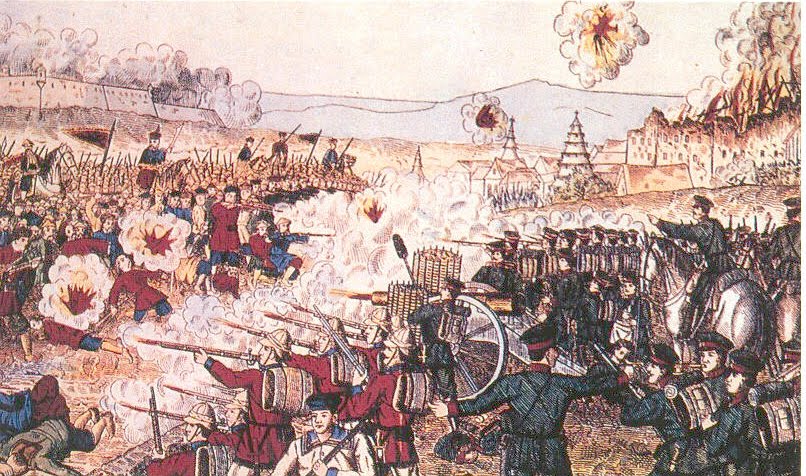
When it comes to history the Chinese have a particularly long memory; and one of the most abiding memories is that of national humiliation at the hands of foreigners. It’s a memory particularly strong among a section of the national community known as the fenqing – angry youth –, who have no interest at all in the values upheld by the Nobel Prize Committee, supporting, rather, a robust version of Chinese nationalism. Without too much exaggeration it’s tempting to see them as the modern Boxers, after the movement involved in the anti-foreign uprising of 1900.

This phenomenon is not entirely new. Unlike the Nationalists, who saw the Boxers as ‘bandits’, the Communists have always taken a more positive view. During the Cultural Revolution Mao’s Red Guards occasionally referred to themselves as the ‘new Boxers.’ Though the Boxer-style violence of the Red Guard has been eschewed by the ruling Communist Party, the original movement is increasingly promoted as an example of anti-imperialist patriotism. In 2009 The People’s Daily published an article praising the Boxers for the panic they had caused among the foreigners trying to carve up China.

It’s all very well, of course, to try to harness into a patriotic tradition but there are dangers here for a regime not always that certain of its continuing hold on power. I can understand that, in a mood of national pride, the Chinese may wish to reinterpret parts of their history. But Boxer violence was not exclusively directed against foreigners. Indeed, far more native Chinese died in their excesses than outsiders. The government of the day, headed by the Empress Dowager Cixi, originally gave encouragement to the movement before they realised the dangers of the dragon. The Communist Party might choose to think that patriotism begins and ends with itself. It does not, as it might eventually discover to its cost.

Monday, 20 June 2011

Jubilant Jubilee


We do not run away from history. We know what the present crisis of capitalism demands of us...we are in the death-throes of late capitalism, which threatens to inflict even greater violence on mankind than it has done before, we must make our stand with the oppressed, with the movement for liberation throughout the world.

Who do you think wrote that? The content and the tone might give you a clue. Could it possibly be Karl Marx and Friedrich Engels, something from The German Ideology or The Communist Manifesto perhaps? It has all the passion of those early works, the eagerness and the anticipation, the determination to surf on history's next big wave.

Actually, it was not the old bearded prophets of communism: it was Archbishop Rowan Williams, the bearded prophet of all sorts of nonsense, from socialism to Sharia. Yes, he co-authored this manifesto in 1974 with one John Seward, a Catholic priest, sitting anticipating the future in an Oxford pub, all dewy of eye and iron of pen. As soon as this pub closes, they sang together, the revolution starts.

Though never published, it was written for the Jubilee Group, a left-wing Christian organisation, which Williams helped found during his student days at Oxford. Alas, the other members, though broadly sympathetic to the view expressed in the Commie Christian Manifesto, declined to accept it, feeling, in the words the Reverend Dr Ken Leech, that it was "a bit of a rant."

Ranting was something Williams did rather well in his distant student days. In the original group manifesto, which was adopted, he said that capitalism "could inflict even greater violence on mankind than it has before". Than it has before what? Perhaps before Jacobinism, socialism and communism came into the world to show how violence was done properly.

Throughout the 1970s and 80s, as the Sunday Telegraph reported yesterday, Williams was a leading member of the Jubilee Group’s executive committee, alongside Tony Benn, now something of a political dinosaur, one Eric Heffer, then an MP, and Reverend Alan Ecclestone, a Communist priest. I'm sure it won't surprise you to learn that the jubilant Jubilees were to be found where the cause needed them, condemning the campaign to free the Falkland Islands from Argentinean generals who were not fascist. No, it was Margaret Thatcher, then prime minister, and the Tory Party who were guilty of "racism and creeping fascism." The Poll Tax was also a big no no, as was the US base at Greenham Common.

Christianity, too, was a bit of a no no, at least as far as the fascist Thatcher and President Ronald Reagan were concerned. In 1989 Williams gave a speech at Edinburgh University, where he talked of the "alarming religiosity of Ronald Reagan and Margaret Thatcher." Yes, it must have been absolutely terrifying to hear them talk of God.

Given his subversive activities it's not at all surprising to discover that Little Red Ranting Hood was put on a watch list by the intelligence services. He came to the attention of MI5 soon after the foundation of the Jubilee Group, principally because of his involvement with Marxist, Trotskyite and socialist campaigners of the usual fifty-seven varieties of the loopy left.

The Jubilee Group itself was identified as a "problem" neo-Marxist organisation in intelligence documents drawn up an MI5 officer named Charles Elwell. Elwell, who died in 2008, had a high profile in the intelligence community. Known as the Witchfinder General, he was the man who cracked the Portland spy ring, identifying the traitor in the Royal Navy who was passing secrets to the Soviets. He specifically highlighted the activities of Williams in a 1989 paper called British Briefing, circulated in secret to a panel of leading politicians, including Lady Thatcher. Soon after she was to say that the Jubilee people were "the most subversive group within the religious community in England.” A newspaper at the time referred to them as "a bunch of neo-Marxist trendy clerics."

Perhaps in years to come I shall feel ashamed of some of the things I say and write at this point in my life, my mid-twenties, my late salad days, when I am still green, actually blue, in judgement. It's not fair, perhaps, to hold one hostage to one’s youth. But that's the thing - Williams is still hostage to his youth, to a whole set of risible ideas; he is still the trendy Marxist priest, ready to attack the government at the drop of a manifesto, who now just happens, by the grace of Blair, another trendy of the day, to occupy the most important clerical office in the land. Dr Leech, his old jubilant comrade, recently said of him "I would not want to commit Rowan to the language of 1974, but it does really show the heart of the theological focus of the man and this has not changed."

I'm still torn between treating the Red Archbishop as a bit of a joke or a serious danger. On balance I think him more comic than serious, though his presence in the Church of England may be part of a deeply laid plan to infiltrate moles, thereby undermining it from within. Given the damage being done to the institution under Williams’ guidance his shadowy handlers must be well pleased. I might even go so far as to say that they must be jubilant.

Sunday, 19 June 2011

Interesting Times


May you live in interesting times, some Chinese sage is alleged to have said at an indeterminate point in the past. It’s a kind of curse; for the time when history is at its most active is also the time that it is at its most dangerous. Actually I quite like the idea of living in interesting times, or at least in times more interesting than the present, a time of tepid mediocrity. I like the idea, for instance, of living in Weimar Germany.

I’ve been reading Before the Deluge: a Portrait of Berlin in the 1920s by Otto Friedrich. Oh bliss was it in that dawn to be alive but to be young, and visit exciting cabarets, was very heaven! I’m only half way through, so I’m not in a position to write a review at the moment. No, I just want to alight on one or two interesting snippets of information.

It’s the paperback edition I have with an introduction by the author written in 1995. However, the text itself has not been updated from the cloth version, published as long ago as 1972, when Berlin was still a divided city, when there were people still alive who could remember events in the 1920s; people who could remember the city of Gustav Kapp, Walther Rathenau and George Grosz, whose images of this time still make compelling art.

It’s the chapter headed A Kind of Madness that I find particularly compelling, that which deals with the post-war inflation. It did not tell me anything that I did not already know, that the mark was effectively worthless by the end of 1923, that savings had been destroyed, that printers were struggling to get an infinity of noughts on to paper that carried greater worth than the currency. No, it was more what people reported, more the practical implications of this human disaster. This was a time when whole apartment blocks could be bought in Berlin for a handful of US dollars.

One of the people the author spoke to was a seventy-five year old journalist who still lived in the city, though now long dead I imagine. “Yes”, she said, “the inflation was the most important event of this period. The inflation wiped out the savings of the entire middle class, but those are just words. You have to realise what they meant. There was not a single girl in the entire German middle class who could get married without her father paying a dowry. Even the maids – they never spent a penny of their wages. They saved and saved sp they could get married. When money became worthless, it destroyed the whole system of getting married, and so it destroyed the idea of remaining chaste until marriage.”

The point is here that while the upper class never lived up to their own standards, and the working class had standards of their own, the bourgeois had always obeyed the rules in outward respectability. One did not have to be a virgin when one married, though it was generally expected. Now the inflation effectively destroyed the price of chastity. In other words, virginity no longer mattered, a form of liberation for women, I suppose, at least Friedrich’s old lady thought so!

The events of 1918, the revolution that was not a revolution, is far from being the most important thing about this time. No, that was the inflation, that revaluation of all values which, as the historian Alan Bullock wrote, undermined the foundations of German society in a way that the war or the collapse of the Kaiserreich or even the Treaty of Versailles had not. The inflation was the real German Revolution, the most interesting time in the country’s history.

Thursday, 16 June 2011

Iron in the Soul


I have one major failing: I simply can’t abide fools. It’s not a question of a person having a different viewpoint from me; that’s a part of life. I can deeply disagree with people while still respecting what they have to say. What angers me is ignorance and the wilful misinterpretation of words. Let me show you what I mean.

I took part in a discussion recently on patriotism, on the meaning of patriotism, specifically directed to one’s own personal feelings on the matter. My answer was simple enough: I said it meant exactly the same thing to me as it did to Rupert Brooke, that golden boy of long-gone golden summer;

If I should die, think only this of me:
That there's some corner of a foreign field
that is forever England. There shall be
in that rich earth a richer dust concealed;
a dust whom England bore, shaped, made aware,
gave, once, her flowers to love, her ways to roam;
a body of England's breathing English air,
washed by the rivers, blest by suns of home.

And think, this heart, all evil shed away,
a pulse in the eternal mind, no less
gives back somewhere the thoughts by England given;
her sights and sounds; dreams happy as her day;
and laughter, learnt of friends; and gentleness,
in hearts at peace, under an English heaven.


It’s a poem by a soldier in the midst of war, a soldier writing from one of the theatres of war, but it’s not about war, not about hatred, not about enmity, not about vainglory; no, it’s simply about home, what home means, what love of home means, the words and sentiments of a patriot. The difference between this and nationalism could not be greater. As I’ve said on a number of occasions, a patriot is a person who loves their country; a nationalist a person who hates everyone else’s country.

In another essay posted last October (England, my England) I defined precisely what England means to me, what it is that defines me specifically as English, in all my uniqueness and eccentricity;

Yes, I’m not British; I’m English. I cycle from my rooms to college most days. I go riding just about every Sunday along old bridal paths. I like gymkhanas and country pursuits in general. I go hunting in season. I have a passion for the history of my country, particularly for the England of the seventeenth century, which has done so much to confirm my belief in the importance of monarchy in our constitution. I enjoy such food as roast beef - though I have a preference for venison -, fresh salmon, scones with high tea and stodgy puddings. I like to be taken punting on the Cam on warm spring days. I like May balls and daffodils. I like strawberries and cream at Wimbledon. I love the plays of William Shakespeare, the poetry of John Donne and the novels of Charles Dickens. I like Tudor and Stuart dance music and the orchestral work of Frederick Delius, particularly Brigg Fair and In a Summer Garden. I like old churches and ruined castles. I have a tremendous affection for the Church of England and an even greater affection for old English folkways. I like Christmas carols, the more traditional the better. I distrust alien ideologies, like socialism, communism and scientology, any form of fanaticism, really, in politics or religion. I distrust political enthusiasm and hero worship. Or if I do like heroes it's historic fatties like Sir John Falstaff or Horace Rumpole! I dislike American spellings of English English words. I like to go to Henley for the regatta and I far prefer tea, English Breakfast, to be precise, to cappuccino!

I am what I am; a single-minded English girl, whose simple love of home entails no harm and does no harm. But then, oh then, came the stupidity, those who could not tell the difference between introspective patriotism and aggressive nationalism, those who persisted in seeing patriotism as a form of wilful ignorance, as a mood of superiority, as a rejection of other nations and other loyalties; that one somehow perceived these as ‘inferior.’ I let rip in my inimitable way, doling out in full measure the kind of response this deserved.

There are some people, sad to say, not just of limited wit but almost completely lacking in basic comprehension. I have no hesitation at all in making a fool look like a fool, condemned not so much by what I say as their own choice of words. I’m neither going to mention the context of this discussion or the people in question. There are those, as Plato says, who only have iron in the soul.

Breathes there the man, with soul so dead,
Who never to himself hath said,
This is my own, my native land!
Whose heart hath ne'er within him burn'd,
As home his footsteps he hath turn'd
From wandering on a foreign strand!
If such there breathe, go, mark him well;
For him no Minstrel raptures swell;
High though his titles, proud his name,
Boundless his wealth as wish can claim;
Despite those titles, power, and pelf,
The wretch, concentred all in self,
Living, shall forfeit fair renown,
And, doubly dying, shall go down
To the vile dust, from whence he sprung,
Unwept, unhonour'd, and unsung.


Wednesday, 15 June 2011

Three Cheers for Elitism


Universities are under tremendous pressure at the moment. Short of funds and with ever increasing demands for places, they have been forced to make hard choices, increasing tuition fees in some cases to the maximum allowed. This is absolutely necessary, especially as the top universities, always under some absurd social engineering imperative from government, no matter its political complexion, have to maintain standards.

The brutal truth is that we have too many students in too many institutions pursuing too many worthless degrees. The result has been the worst kind of academic inflation. We are sending people into higher education who should not be there, all in the name of equality. In present circumstances limited resources, too many bodies and too many third and fourth rate courses is a recipe for mediocrity and decline.

Above all the discrimination against the brightest and the best, those who are most able to make a meaningful contribution to university life, in favour of less well placed people, is disastrously ill-judged. Oh we mustn’t have elitism, the mantra goes. Yes, we must; the best must be allowed to be the best. I make no apology for embracing elitism. We are not all equal; we will never all be equal.

There is a terrible logjam in higher education, or better a Gordian Knot that needs to be cut. What better way of getting around spending restrictions and social engineering than founding a new university, one that will make no demands on the public purse, one based on private investment, one that can charge fees beyond present limits, one that can attract students, well-qualified in every respect, people who have been frustrated elsewhere but who can afford to pay for their education. Yes, an excellent idea, if only someone had sufficient vision and courage.

Someone does. Anthony Clifford Grayling, formerly professor of philosophy at Birkbeck, does. Last week he announced the creation of the New College of the Humanities in London, a venture which will be privately funded, where students will be charged double the existing fee levels allowed for by institutions beholden to government. It’s a bold, imaginative step, one which places particular stress on the humanities, under such pressure elsewhere. Boris Jonhson, the Mayor of London, has welcomed it, I welcome it and, as the Economist says, there is a market for the idea.

Some do not welcome it, including those who forced Grayling to abandon a public talk in Foyle’s bookshop in central London after smoke bombs were thrown. I can just imagine who it was, the same sub-literate oiks who despoiled the cenotaph last year in protests against the rise in tuition fees. Before this one shouted from the crowd “You have no right to speak”, then going on to demonstrate that he would have no opportunity to speak.

But the worst of all, the greatest oiks of all, are the academics who have condemned the New Humanities project as ‘elitist’, the horror, the horror. These include Professor Terry Eagleton, a Marxist literary theorist, who described it as a “disgustingly elitist outfit”, that Grayling had betrayed other academics by “jumping ship and creaming off the bright and the loaded.” This from a man who spends three weeks every year teaching at a private university in America which charges students £27,000 per annum, where he is paid a whacking great fee, as Grayling pointed out in the Times on Saturday. The stench of hypocrisy truly is overwhelming.

I hope the New College is a tremendous success. I hope it does attract all those people who can’t get places at Oxbridge because it upsets Nick Clegg too much, since they come from the ‘wrong’ background. We need an awful lot more elitism, the elitism upon which this country and its best educational institutions was built.

Tuesday, 14 June 2011

No stomach to this fight


I voted Conservative in the general election of 2010. It wasn’t the first time I voted; no, that was in the election of 2005, just before my nineteenth birthday, full of passionate hatred for the warmongering Labour government of Tony Blair, full of hatred for any form of hard Labour, old or new. The outcome was a sad disappointment.

I was disappointed in 2010 also, disappointed that David Cameron had not won an outright victory. It was tempered with some pleasure that we had a kind of Conservative government but concerned that it had to be diluted by a bargain with the ghastly Liberal Democrats, the know nothing, do nothing party; the yellow party.

Now I’ve had enough; I’ve had enough of Cameron, this ‘heir to Blair.’ Actually he’s turning out to be part Blair – foreign war is quite the thing – and part Grocer Heath, Mr U-turn himself, the man who sold this country to Europe, the act of a political Judas. Cameron, too, is betraying the country in his abject cowardice towards Europe, something I’ll come to a bit later. First I want to say a word or two about Clegg and his gang, the tail wagging the Cameron dog.

No decent Conservative should put up with these people. They got a bloody nose in May, both in the local elections and in the Alternative Vote referendum. Hardly anybody wants them, this wretched party that belongs neither here nor there, neither of the left nor the right, but a soggy middle. If we had an election now I’m convinced that we would have another and more complete Strange Death of Liberal England, a prospect I wholeheartedly welcome.

Yes, they lost and ever since they’ve been desperate to ‘get it up’, to demonstrate a more ‘muscular’ Liberalism, with that grumpy old ass Vince Cable, a political Victor Meldrew, breaking solidarity that in the past would led to swift ejection from office. But he wants to moan from the comfort of a ministerial car.

Now Clegg and his gang are crowing about their ‘victory’ in making a mockery of the proposed reforms in the National Health Service. Paddy Ashdown, also known as Paddy Pants Down, a reference to past sexual shenanigans, says that Clegg, his fag, ‘played a blinder on this.’ Oh, in case of any misunderstanding here I should add that a ‘fag’ in this context does not mean what you may think it means. No, it’s the old practice in public schools of the younger boys acting as servants for the seniors!

So Cameron is made to look like a fool by these school boyish pranks, this laughable one-upmanship by Fag Clegg. He has little if any room for manoeuvre because his trick circus is all based on balance, the Limp Dumbs having marked out their pissing territory. This includes Energy and Climate Change, presided over by Chris Huhne, otherwise Windmill Man or Mister Hypothermia, who is likely to turn out to be one of the greatest mass murders of old people in history.

But let’s pretend that Paddy Pants Down, Vince ‘I don’t believe it’ Cable, Clegg the Fag Boy and Hypothermia Huhne are all a bad dream, that David Cameron won outright last year, as he should have against one of the most incompetent governments in history. Let’s pretend there is a Tory majority, dedicated to cutting the worst deficit we have ever accumulated.

What then? Drastic savings, a more realistic appreciation of our diminished role in the world? No, of course not: let’s bomb Libya, let’s waste more money, money we are being told we don’t have, on a futile foreign war. That’s the Blair way, after all. Oh, I almost forgot - let’s ensure that charity begins everywhere but home by ring-fencing the foreign aid budget.

The Heath way, the other Cameron route, is on Europe. There was an excellent letter in the Sunday Telegraph from one Charles Bell, pointing out the Prime Minister’s multiple failings on Europe. While an ever increasing burden is being placed on tax payers, no attempt has been made to reduce our contributions to the profligate European Union. No, pensioners will freeze this winter, unable to pay energy bills inflated by green taxes, while Herman van Rumpay, the risible Mister Euro Smurf, the make-pretend President, and Manuel Barroso, the other President, jet around the place in separate crafts because they are too jealous of each other to share!

Cameron has done nothing, moreover, to reclaim our legal sovereignty, lost with the wholesale digestion of the Human Rights Act. We can’t deport foreign-born criminals because they ‘have a right to a family life’ here, as defined by the Act and as interpreted by the courts. Bit by bit our sovereignty dies while Cameron only has time to stand and stare.

Oh, but he can’t clear out the nonsense of human rights legislation because the Limp Dumbs would not like it, which brings me back to my essential point: this Coalition is a liability, it makes Cameron look more ridiculous by the day, makes the Conservative Party look inept, cursed with the awful Liberal albatross.

Now is the time to go for a general election: Labour looks more hopeless than ever under Ed Millipede and the Liberal Democrats will suffer a political Armageddon. But Cameron, I regret to say, has no stomach to this fight. I can only wish that he would depart. I would personally make out his passport and put crowns for convoy into his purse.