Monday, 16 August 2010

A Lonely Impulse of Delight


My obsession with aviation continues, particularly with the pioneering days of flight. To add to Amelia Earhart I now have other aviatrix heroines, people like Amy Johnson, Jean Batten and Beryl Markham. I have the latter’s West with the Night, a memoir of life and flying and adventure in Africa at a time when life was raw and dangerous and beautiful. Her skill as a writer even managed to incur the admiration and the jealous ire of Ernest Hemingway;

Did you read Beryl Markham's book, West With The Night? ...She has written so well, and marvellously well, that I was completely ashamed of myself as a writer. I felt that I was simply a carpenter with words, picking up whatever was furnished on the job and nailing them together and sometimes making an okay pig pen. But this girl, who is to my knowledge very unpleasant and we might even say a high-grade bitch, can write rings around all of us who consider ourselves as writers ... it really is a bloody wonderful book.

These stories of flyers and the impact they made on the imagination just move me so much; the myth of the aviator moves me so much. Some of the associations, though, are more than a little dubious. In 1935 Guido Mattoli published Mussolini Aviator, and his Work for Aviation in which he makes the following observation;

No machine requires so much human concentration of soul and will power as a flying machine to make it work properly. The pilot understands the fullest meaning of the word control. Thus it seems that there is an intimate spiritual link between Fascism and Flying. Every airman is a born Fascist.

Every aviatrix is not! Still, I do understand some of the sentiments here, those about power and control, though flying light aircraft now is clearly a lot less challenging than it was then.

Yes, I suppose there is an element of mythology and myth-making, about forms of self-empowerment and freedom that have motivated people almost since the beginning of time. It’s the dream of Daedalus, if I can put it in such impractically romantic terms. Nietzsche understood. In a passage reflecting on physical constraints of bird flight he writes;

But who could venture to infer from that, that there was not an immense open space before them, that they had flown as far as one could fly!...other birds will fly further!

Other birds have flown further!

I saw this old war movie on TV one Saturday afternoon ages ago. It’s called The Blue Max, if I remember correctly, about German airmen during the First World War. It opens with a remarkable scene with a soldier looking up from the mud of the trenches to see an air battle; to see amongst mechanised death that there is still something left of combat of ages past, where individual is pitted against individual, like knights in the sky. This brings to mind a poem, one by Yeats, about flying, war and personal destiny, the marvellous, marvellous words of “An Irish Airman Foresees his Death”;

I know that I shall meet my fate
Somewhere among the clouds above:
Those that I fight I do not hate,
Those that I guard I do not love:
My country is Kiltartan Cross,
My countrymen Kiltartan's poor,
No likely end could bring them loss
Or leave them happier than before.
Nor law, nor duty bade me fight,
Nor public men, nor cheering crowds,
A lonely impulse of delight
Drove to this tumult in the clouds;
I balanced all, brought all to mind,
The years to come seemed waste of breath,
A waste of breath the years behind
In balance with this life, this death.


The Brilliance of Bunin


I recently mentioned the Russian writer Ivan Bunin in another blog. I’d like to say a little bit more about him, about a literary genius who deserves to be far better known and appreciated in the English-speaking world.

I ‘discovered’ Bunin in my late teens in a collection entitled The Gentleman from San Francisco and Other Stories - published some years ago by Penguin Books - tucked away in father’s library among books he had accumulated in his student days. I was immediately captivated by the sharpness of the author’s prose, the economy of his style and the poetic beauty of his imagery.

Here was a writer, it seemed to me, who bore comparison with Chekhov, another great master of the short story. But Bunin was different, more intimate, more Proustian, more poignantly introspective. Above all he seemed to have a more acute sense of the beauty and the fleeting tragedy of life.

Like Tolstoy, Bunin came from a long line of Russian aristocrats and serf-owners. He achieved popular and critical success in his native land with his poetry and early short stories, confirmed by the publication in 1910 of The Village, his first full-length novel. But this world, the prospects opened by his creative genius, came to an end when the Bolsheviks took control of Russia in 1917. Bunin records his experience of the ensuing Civil War, as I mentioned previously, in diaries published as Cursed Days, of which I intend to say a little more.

With the final victory of the communists Bunin left Russia, spending the rest of his life as an émigré, latterly in France, where he lived through the Nazi occupation. He continued to write, producing some of his greatest works, achieving sufficient recognition to be awarded the Nobel Prize for Literature in 1933, the first Russian ever to have received this honour.

But as he published in his native language, and as his work was banned in the Soviet Union, where he was condemned as a ‘traitor’ (to be condemned by the communists; how proud he must have been), he was only ever able to reach a relatively small audience, declining with the years. He died in the south of France in 1953, sinking steadily into quiet obscurity.

Coming to Bunin for the first time you are likely to notice that there is none of the grand moralising and philosophising that is such a feature of Russian literature, such a feature of Tolstoy and Dostoevsky. Bunin’s vision, rather, is much more personal and intimate. There is also a sense of the impermanence of all things, of worlds that can close down in an instant, taken away in a moment. The paradox is that this makes passing joys all the greater, all the more intense; joys like human love, at once here and then gone forever, butterflies on a summer’s day. It’s all so futile; it’s all so beautiful.

Sexual love is another of his themes, something he explores in intimate detail in the collection of stories called Dark Avenues. Most of the tales end unhappily, everything in life ends unhappily, but they are not in the least dispiriting. The beauty of the moment is all that counts, all one can ever hope for. Despair may be the price of rapture but it is a price well worth paying; believe me, it is.

Present joys and future regrets is one thread that flows through Bunin’s work, the other is nostalgia, a sense of loss, loss of the past, loss of home and loss of place. His Russia, gone forever, is recreated in memory in the most beautiful, elegiac terms. Even his language, his mode of expression, is of the past, free of the corruptions inflicted on Russian prose by the communists. He escaped and how thankful I am for that. There was no way a man of his background, his sensitivity and his outlook could have survived the contagion that was consuming his land. His frustration and fears are fully expressed in Cursed Days, two extracts from which I have taken at random;

Odessa, May 3, 1919. How fiercely everyone yearns for the Bolsheviks to perish! There’s not the most terrible biblical punishment that we would not wish on them. If the devil himself burst into the city and literally go about with Bolshevik blood up to his neck, half of Odessa would weep with joy.

Odessa, May 5, 1919. Generally speaking as soon as a city becomes “red” the crowd that fills the streets changes suddenly and rapidly…There is nothing simple or ordinary about these faces. They are almost all so extremely and sharply repulsive, so frightening in their evil dullness, that they constitute a threatening, lackeylike challenge to everyone and everything.

If he had stayed he would quite likely have suffered the same fate of Nikolai Gumilev. In which case the world would have lost so much; I would have lost so much

Saddle-sore, tired and happy


I arrived back from Central America last Wednesday afternoon and I’ve been suffering ever since from the most awful jet-lag, the worst I have ever experienced. It’s partially my fault in that I had a long nap when I got home, something I’ve always avoided in the past, no matter how tired.

Anyway, my internal clock has been refusing to shift from New World time. Saturday was possibly the worst. Not only was I up for most of the night but I made dinner at three o’clock in the morning!

So that’s it; I’ve had enough. On Sunday I went to the stables to reacquaint myself with a certain horse. I was going riding anyway but I decided to take advantage of some decent weather to give Annette and I as much exercise as possible, a spot of jumping followed by a lengthy hack. I did not get back home until well into the evening, a little saddle sore and pleasantly tired. After some late-night writing I went to bed, settled in both mind and body. I’m pleased to say that I slept beautifully, with dreams of floating above the clouds.

Oh, yes, Annette was pleased to see me after she stopped being standoffish and huffy. Horses do have personalities, and mine has more personality than most. :-)

Sunday, 15 August 2010

Super Oik


Every summer the British monarch hosts parties in the gardens of Buckingham Palace, a tradition that goes back to the days of Queen Victoria. Originally intended as a reception for debutants they are now used as a form of recognition for various people in public life. Politicians are often included though it is not a political event. But this year an attempt was made to turn it into a political event, the first time ever, so far as I am aware. By whom, you ask? By a frightful and vulgar little oik called Nick Griffin.

English people will be all too aware exactly who this man is and what he represents. For those who do not he is the leader of the British National Party and a member of the European Parliament. This party, little more than a collection of thugs and desperados, is supposedly of the extreme ‘right’, though I will have something more to say on this particular point a little further on. Griffin himself certainly has some dubious Nazi-style political credentials, as well as a conviction for distributing material likely to incite racial hatred.

None of this matters. He was invited to Buckingham Palace, as was Andrew Brons, his fellow party member and MEP, because he has a position in public life and the monarchy takes a strictly neutral stand in politics, even condescending to low class and unpleasant people like this.

But Griffin, always the mouth, always looking for publicity value, started to make play of his honour: he started to use it in a wholly shameful fashion, true to his vulgar nature. He sent out an email to supporters asking them for suggestions on what he should ‘tell’ the Queen if he got an opportunity to speak to her – not that it was very likely - as well as making heavy use of his invitation in the media. As a result, and quite properly, he was banned from attending, to the relief of almost everyone else, I feel sure. The fact that no political discrimination was involved was evidenced by the fact that there was no similar interdict on Brons.

I’ve been following Griffin ever since he appeared last year on Question Time, a BBC television question and answer show, on which he gave an acutely embarrassing performance. It should be possible to watch extracts on YouTube to get a flavour both of his intellect and style. When I say ‘follow’ I mean I signed up on the BNP site for news alerts. I know, I know, but sometimes one simply has to get one’s hands dirty! The reason I know about the Buck House business, having been out of the loop of British politics for some weeks, is because there was an email from him in my inbox, addressed to ‘Dear Fellow Patriot’, lamenting this “totalitarian ban.” He went on to say that it was almost impossible to find anyone who agreed with it. Well, I do, Dear Fellow Patriot that I am!

Never mind his loathsome politics; this man has no class, no style at all. Once again he has been shown up as a buffoon. I honestly can’t believe he managed to get a place at Cambridge, where he attended Downing College. All I will say is that he seems to have left very little trace of himself. Personally I find him quite the ugliest looking creature I’ve ever come across, with his weird facial expressions, not helped by a dead glass eye. If there is ever a remake of Frankenstein he might very well serve as the monster, except that would be unfair to monsters past!

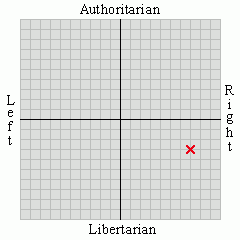
Now let me say a word or two about the politics of the British National Party. People who do not reflect too deeply on these matters generally describe it as of the far right, or that it is ‘fascist.’ Insofar as the party embraces an unpleasant form of ‘patriotism’, based, really, on a deep sense of inferiority, yes, I suppose it can be put in the latter category, though I think that unfair to people like Mussolini, Franco and Jose Antonio Primo de Rivera. But the thing is, in terms of strict political taxonomy, it does not belong to the political right at all.

There is virtually nothing to distinguish the programme of the BNP, when it comes to social and economic issues, from the politics of Old Labour; it’s the same heavy, clunking, ruinous policy of statism and welfarism that so failed this country in the past. It’s as authoritarian and interventionist as New Labour and all other shades of the trendy left. Even the BNP’s base of support is drawn from the traditional working class, those who felt abandoned by Tony Blair and the Islington liberals.

I like to think of myself as right wing, though as far removed from Nasty Nick as it is possible to get This is how I once described my politics in a debate on another blog site;

"At the risk of getting bogged down in semantics I will tell you what I understand by the politics of the right, the things that make me right wing. I believe in classic laissez-faire capitalism; I believe in liberty, taken as far as it can within the bounds of the law; I want to minimise the role of the state, I want to reduce it to the point where it exists simply as a guarantor of liberty, no more than that. I think welfarism is corrosive, corrosive of liberty and corrosive of self-respect. I want taxation reduced to an absolute minimum, allowing people to be free to spend their earnings as they wish. I distrust and despise collectivist and statist ideologies of all kinds. My libertarianism even pushes to the frontiers of anarchism; so does that make me ‘left-wing’?”

Since I wrote this I’ve come across a splendid passage in Cursed Days, Ivan Bunin’s account of his experiences in the Russian Civil War. Bunin, a former Nobel laureate and one of my favourite writers, says;

I am not of the left or the right. I have been, am, and will be an implacable enemy of everything that is stupid and divorced from life, of all that is evil, false, dishonest and harmful, whatever its source.

He was writing as his country was in the possession of one of the most evil, false and dishonest ideologies ever devised. False and dishonest ideologies are always with us, just as people like Griffin are always with us, purveyors of some second-hand, second-class idea. I certainly would not want to come across this over-dressed idiot in the company, no matter how remote, of our own dear Queen.

Saturday, 14 August 2010

A Voice from the Past


Nikolai Gumilev has a page on Facebook. Only ten people ‘like’ it – eleven, now that I have added myself – but at least he has a page, rather a surprise, really, given that he is now almost unknown in the English-speaking world, almost unknown outside his native Russia.

Who was he, you might ask? He was a poet, far from being the greatest in a land of great poets, one with an almost limitless and playful imagination; one who appeals to my own romantic and political vision. Like Arthur Rimbaud, another of my favourites, he was fascinated by Africa in the way that I am fascinated by Africa.

Gumilev was also a patriot, a lover of Russia, a hater of the Bolsheviks, those sub-human political gangsters who took control of the country in a military coup in late 1917. He did nothing to hide his contempt, nothing to disguise the fact that he was a committed ‘counter-revolutionary.’ In August 1921 he was arrested by Cheka, the Soviet secret police, and subsequently executed for his part in a monarchist conspiracy. His burial place is still unknown.

To the People of the Future

This single link was else respected
By people of the days that gone –
There’s written on its tablet sacred
That Love and Life is one.
But you’re not they, you live like arrows
Of dreams that fly through skies and earth,
And in your flight, unite, my fellows,
The Love and Death.

They said in their pledge eternal
That they are slaves of the bad past,
That they were born in dust infernal,
And will return again to dust.
Your heedless brightness was aroused
By songs of lyre, mad and fine,
Eternity will be your spouse,
The world – a shrine.


All folk were utterly believing
That they must live and love with smiles,
That woman is a child of sinning,
Who’s marked by sins a hundred times.
But different, unearthly sounds
Were brought to you by running years,
And you will take to Snow Crowns
Your gentle friends.

Life and Love


Three years ago I went to see La vie en Rose, a French biopic about the life of the wonderful Edith Piaf. I’ve now seen Gainsbourg, vie héroïque a portrait of Serge Gainsbourg, another French cultural icon. By coincidence – completely unaware that this movie was on the point of release – I wrote a blog a few weeks ago about Je t'aime... moi non plus (The Sexiest Love Song Ever Written), his famously infamous duet with Jane Birkin. Is the movie as sexy? No, but it has some deliciously orgasmic moments!

Gainsbourg was directed by Joann Sfar, probably better known as an artist and creator of comic books than a movie maker. Among his influences is the painting of Marc Chagall, which shows strongly in some of the movie’s more surreal moments. There are some fine performances, particularly from Eric Elmosnino as Gainsbourg, a part he was born to play on the basis of his looks alone, Laetitia Casta as Bridget Bardot and Lucy Gordon as Jane Birkin, the great love of Gainsbourg’s life insofar as any woman can be said to have commanded that demanding part.

Gainsbourg as a composer and song writer is one of these people it’s almost impossible to classify, his work crossing so many boundaries. The movie tries to cover as much of his style as possible, and therein lies the problem, or part of a problem: it’s simply too ambitious, ambitious to the point of being breathless.

The other problem is that the director has eschewed a straightforward chronological format, which rather makes the life a little difficult to follow, proceeding by unexplained leaps. Sfar’s makes full use of his talent for cartoon imagery and caricature, highly effective at points, though rather at the price of proper dramatic and narrative focus.

The story really begins in war-time France where Lucien, as Gainsbourg was then known, grew up as the son of Russian Jewish immigrants, a double outsider, a foreigner and a Jew. Although the mature artist was quintessentially French, his ‘otherness’, and his perceived ugliness, was to haunt him all his life.

As a boy he is pursued –literally –by a grotesque anti-Semitic caricature, one that jumps out of a poster on a Parisian wall. This later transforms into a puppet alter-ego, one that exaggerates his own pronounced Semitic features, one that continually exposes his self doubt as well as inspiring his subversive genius. In the cast honours I really should also mention Kacey Klein who plays the young Gainsbourg, cocky and assured, in some of the movie’s best scenes.

Thereafter the life and the art crams in, so much so that Sfar seems overwhelmed by the material, moving from song to song, episode to episode, love to love in a breathless, somewhat impressionistic matter. Casta’s entrance as Bardot is sublime but Gordon as Birkin rather ‘drops down’, so to speak, without preamble or introduction. Then comes that song, that wonderful sexy masterpiece, sung in the original, as the couple bathe together in a golden light, for me the highlight of the movie.

Controversial as Je t’aime was it seems not to have been nearly as controversial as another song, at least in his native France. After he recorded a reggae version of La Marseilles he was confronted once again by his ‘otherness’, washed over by waves of aggressive anti-Semitism. One notice said that he had brought this on himself by his ‘provocations’, the kind of vicious casuistry that would not have been out of place in Vichy. We see him confronting a group of beret-wearing veterans, angered by this alleged insult to the national anthem, reminding them that it is a song for rebels and that he is a rebel. As he proceeds to sing the berets are quickly removed!

There is more good work to come but Gainsbourg’s capacity for self-destruction steadily takes hold: he drinks too much, he smokes too much, he lives too much, he loves too much.

Looking back over what I’ve written I begin to feel that I may appear more negative than necessary. I do stress that I enjoyed this movie; I enjoyed some of Sfar’s treatment of the subject. I could see what he was aiming at. It’s just that this was a large life of a larger than life figure, described after his death by President Mitterrand himself as “our Baudelaire, our Apollinaire”. Sfar has reduced it to a series of cameos, some good, others less so, not just out of artistic preference but as a way, I suspect, of coping with the complexity.

Finally, I should say that I came away feeling really sad, sad that the beautiful and talented Lucy Gordon took her own life last year in Paris. She was a wonderful Birkin, utterly convincing as ‘Little Miss England’. Gainsbourg will serve as a lasting tribute.


Friday, 13 August 2010

The Wanderer Returns


The wanderer returns with tales to tell; of rough quarries, rocks and hills whose heads touch heaven, it was my hint to speak, — such was the process; and of the Cannibals that each other eat, the Anthropophagi and men whose heads do grow beneath their shoulders. Well, not exactly, but there is so much more almost as wonderful!

To begin with I have to say that we were far too ambitious, our programme was too ambitious. I did not make it to southern Mexico, as I had intended, though I did manage the other places in my peregrination through Central America, from Guatemala to Panama. I spent several days in Honduras though not as much as I would have liked because of a major outbreak of dengue fever, a mosquito-borne disease, which caused the government to declare a state of emergency in June. We kept an eye on the latest news, in the end deciding that life was all risk, and since we were here we might as well be there!

Anyway, we arrived in Guatemala, so it is with Guatemala that I shall begin. One of the chief reasons for coming here was to go back to Tikal, to explore the superb Mayan ruins at greater length. We flew from Guatemala City on a three-day trip, an odd experience in itself because we had to wait for a heavy morning mist to clear before take off, the last thing I expected. Oh, but it was worth it, those temples are tremendous, far more impressive than the Egyptian pyramids. The jungle setting is also something special, with monkeys and macaws calling from among the trees.

It’s possible to spend weeks here without covering the full complexity of the Maya, their architecture and their culture. We had a guide for the first day but for the rest of the time we explored some of the lesser known sites on our own with the aid of a map, something recommended in the Rough Guide handbook, my indispensible travel bible! Among other parts of the site we visited the Mundo Perdido – the Lost World (yes, I know; shades of Conan Doyle!) – home of the thirty-two meter high Great Pyramid, which stands on the site of earlier structures, the oldest dating back to 500BC.


There was another Mayan site I had to visit, that at Augateca, not simply because are reported to be among the best, but because getting there involves an additional adventure as the place is accessible only by canoe, situated, as it is, on the Petexbatun Lagoon. The whole thing was terribly worthwhile, and while the remains are not as impressive as those at Tikal there are fewer tourists and more archaeologists. The setting itself is also quite spectacular, a visit accompanied by an unforgettable chorus of howler monkeys!


From ancient days we travelled through space and time, going on to the city of Antigua, formerly one of the treasures of Spanish America. It’s a charming place, a lot less nerve-racking than Guatemala City, with some lovely colonial-style architecture, though parts of it much abused by repeated earthquakes. We had a couple of days here, not just soaking up the atmosphere but experiencing the insane night-life, drinking tequila shorts with some lovely American boys who adopted me as a kind of mascot!

Still keeping an eye on Honduras, we went to Costa Rica next, here looking for drama in nature rather than drama in history. Basing ourselves in San Jose, the capital, a place I do not recommend, we went volcano hopping. I’ve been to the top of fire mountains before but I’ve never actually seen into the craters because they have usually been heavily draped in mist. I’m told that from the top of Mount Irazu it’s possible to see all the way to the Caribbean coast. I will just have to take the guidebook’s word for it because my vision was limited to a few meters in all directions!

After some vigorous appeals to Vulcan I’m delighted to say that the mists on the top of Mount Poas cleared just enough for me to get a good view into the crater. The thing is, as volcano baggers will know, even when one cannot see them one can certainly taste them, that sulphurous flavour that hits the back of one’s palate.


Jungle exploration was another Costa Rican experience, though this time flying through the treetops of the Monteverde Cloud Forest, a quite fantastic experience, rushing from zip line to zip line. I also did a spot of canoeing. I did not see as many monkeys as I did in Guatemala just sloths, sloths and more sloths, creatures which really do deserve their name! Actually I did see quite a lot more - crocodiles, turtles and some wonderfully exotic birds, including my very first toucan.

So, here we are, over a week and a half into the safari and I’ve still not been to Honduras. That’s it; no more hesitating; it’s time to go and the Devil goes with me...along with my boyfriend (is there a difference?)

I’m so glad we went. The dengue emergency was passing and Tegucigalpa, the capital, was perfectly calm, with no sign at all of any kind of political trouble. I stayed here for two days exploring, bar-hopping and generally getting to know people. I’m pleased to say that I did not come across anyone who had a good word to say about Manuel Zelaya, the ousted president and dictator in the making. Perhaps I just spoke to the wrong people…or went to the wrong bars!

I have to say that Tegucigalpa, though certainly a tad more interesting than San Jose, is not really the kind of place where one needs to spend an awful lot of time. There is some interesting colonial architecture in the centre but that’s not what I was here for; no, it was on to Copan and the Mayans.

Copan itself is a lovely place, far more relaxed than the capital. The ruins lie approximately two kilometres to the east of the town. Before entering the site properly we spent some time looking at the superb collection in the Museum of Mayan Sculpture. Although the Copan Ruins are not nearly as spectacular as Tikal there are some really super sculptures, reliefs and alters. Some of the temples are also truly special, particularly the cluster in the area known as the Acropolis. I know this has probably been said many times before but the Hieroglyphic Stair way left me speechless with excitement.

After a fairly intense few days it was back to Tegucigalpa and from there on to Panama. I’ve now seen several Central American capitals but there is nothing to compare to Panama City. Looking at those soaring skyscrapers, known locally as the ‘Cocaine Towers’, as one approaches the city across the causeway makes ever other place seem so provincial.

Again we did a lot of exploration here, particularly in the ruins of Panama Viejo – Old Panama – abandoned in the seventeenth century after it was ransacked by a certain unscrupulous English buccaneer by the name of Henry Morgan! But Panama was chiefly for relaxing, playing, beaching and having lots of fun. My most memorable experience will probably be the super luncheon with new friends in the Restaurant Mira Flores, overlooking the Panama Canal.

Yes, we did spend lots of time exploring throughout the trip but this was punctuated by all sorts of other activities, swimming, talking, making friends, being generally laid back and super cool. I also managed to get in a spot of riding in both Honduras and Guatemala, including one splendid gallop along a largely deserted volcanic beach. The whole trip was such a tremendous experience. I could have spent twice as long but here we are, England, home and beauty.

The world is a book, and those who do not travel, read only a page.